
Overview
GenFutures Lab partnered with the Arab Open University as a sponsor and delivery partner for the International Summit on AI Horizons 2026. The engagement brought together academia, industry, and government through a keynote, a hands-on student workshop, and a fireside chat.
The focus was not AI in the abstract, but how emerging advances can be translated into practical, responsible adoption. Framed against Kuwait Vision 2035, the work connected AI innovation to real educational needs, national priorities, and the conditions required for trusted implementation.
Approach
We designed a layered experience that combined strategic perspective with practical application.
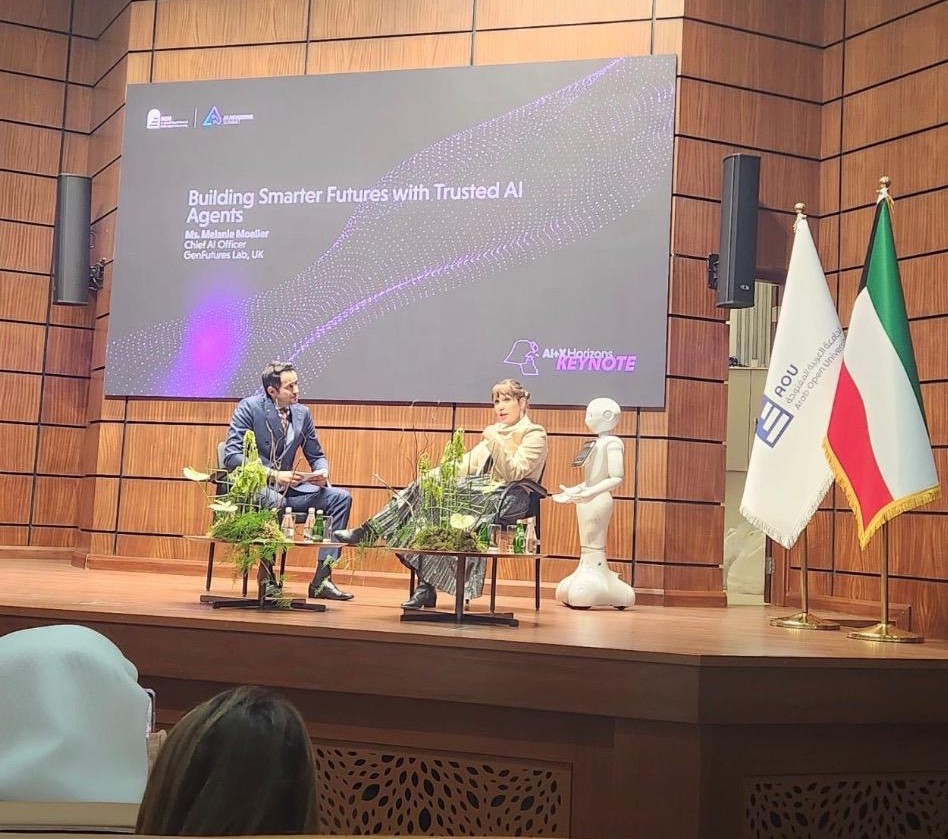
Keynote: Building Smarter Futures with Trusted AI Agents
The keynote introduced the shift from generative AI to agentic AI, showing how AI systems can perceive, plan, act, and reflect in real-world contexts. The session emphasised trust, governance, and human oversight as essential to scaling AI responsibly.
Applied innovation: BABA
We developed and presented the Bilingual Academic Bridge Agent, or BABA, a purpose-built AI agent designed for the university context. BABA supports students in both English and Arabic, helping explain concepts, strengthen academic writing, and guide learning through structured feedback and self-checks. It provided a concrete example of how AI can be implemented in ways that are useful, accessible, and context-specific.
Strategic alignment
AI use cases were linked to Kuwait Vision 2035 priorities, including education, public services, and economic diversification. This helped ground the conversation in practical national relevance, rather than treating AI as a standalone innovation topic.
Workshop: Applied AI Essentials
We delivered a hands-on student workshop focused on real-world application. Participants learned prompting frameworks including RTF, RISEN, and RODES, then applied them across tasks such as research, writing, and data analysis.
Fireside chat
In conversation with Dr. Mohamed Adnan Hamouri, the discussion focused on the realities of implementation. Key themes included starting with value rather than technology, the importance of data and skills, and why lightweight, risk-based governance can accelerate rather than slow adoption. The discussion also explored the wider shift towards more experimental and iterative operating models in AI-enabled organisations.
Outcomes and impact
Capability building
Students developed practical AI skills they could apply immediately in academic work and future professional settings.
Applied innovation in context
BABA showed how a purpose-built AI agent can enhance learning, particularly in bilingual and diverse educational environments.
Strategic clarity
By linking AI to Kuwait Vision 2035, the summit positioned AI as an enabler of wider educational, economic, and public-sector transformation.
Stakeholder engagement
The summit created valuable connections with regional leaders, including Prince Abdulaziz bin Talal Al-Saud, Chairman of the AOU Board of Trustees, as well as government representatives exploring and championing AI adoption. It also provided an opportunity to connect with AOU President in the Arab World, Prof. Mohammed Zakari, and Vice President of Planning and Development and CIO, Prof. Omar Al-Jarrah, and to hear their perspectives on AI innovation and their ambitions for AOU and the wider education sector.
Regional credibility
The engagement strengthened GenFutures Lab’s presence in the Gulf and reinforced its positioning as a partner that combines AI strategy, capability building, and responsible implementation.
Key takeaway
This engagement showed how thought leadership, robust research, practical enablement, and real-world prototypes can work together to accelerate AI adoption. It also reflected a wider market shift: organisations do not just need AI inspiration, they need practical ways to apply it with trust, relevance, and real value.