Bots Just Took Over The Web

Bots Just Took Over The Web

FutureShifts | First June 2026 Edition 

For most of the internet’s history, there has been an assumption so fundamental that few people ever questioned it: the web exists for humans.

That assumption has now been overtaken, literally, by the data.

This week’s piece explores what it means for the commercial architecture of the internet when machines generate more web requests than people, who gets hurt first, and what nobody has yet figured out how to fix. It also covers nine major AI developments from the past week.

Dive in and let us know what you think!


🗞️AI in Focus: Recent Developments

1. Anthropic expands Project Glasswing to 200 organisations across 15 countries

Anthropic extended access to Claude Mythos Preview, its most capable and publicly unavailable model, to 200 organisations including NATO, ENISA, Okta, Samsung, Swift and Euroclear. The first 50 partners had already identified more than 10,000 critical software vulnerabilities. The expansion arrived the day after Anthropic confidentially filed for an IPO at a reported valuation of approximately $965 billion, a figure that, if accurate, would place Anthropic among the most valuable companies ever to seek a public listing. Sources: 1 2

2. Anthropic Institute publishes report warning of accelerating AI self-improvement

Researchers at the Anthropic Institute warned that AI designing its own successor is approaching faster than governments are prepared for. The report stated Anthropic would support a coordinated slowdown if other frontier labs agreed to verifiable conditions, stopping short of a formal call for an immediate pause. Over 80 per cent of code at Anthropic is now authored by Claude rather than humans. Sources: 1 2

3. Microsoft repositions Windows as a platform for AI agents

At Build 2026, Microsoft unveiled the Windows Agent Runtime Service, an always-on enterprise agent called Scout and seven in-house models under the MAI name. The flagship MAI-Thinking-1 carries a 256,000-token context window and Microsoft says it was trained entirely on commercially licensed data. Sources: 1 2

4. DeepSeek raises $7.4 billion in its first-ever external funding round

The Chinese lab that matched frontier model performance at a fraction of the cost has ended its self-funded model, raising at a valuation of $52 billion to $59 billion. The entirely domestic investor lineup, Tencent, CATL, NetEase and JD.com, signals a deliberate commitment to building within China’s hardware and regulatory ecosystem. Source

5. Ideogram releases 4.0, its first open-weight frontier image model

The 9.3-billion-parameter model generates native 2K images with accurate multilingual text rendering and structured layout controls, ranking first on the DesignArena benchmark among open-weight image models at launch, below only closed models from OpenAI and Google. Sources: 1 2

6. NVIDIA and Uber announce a commercial robotaxi programme in Munich

NVIDIA, Uber and Israeli firm Autobrains announced what the companies describe as the first commercial autonomous ride-hailing programme in a major German city, built on NVIDIA’s DRIVE Hyperion platform and pending regulatory approval. Sources: 1 2

7. NVIDIA unveils Isaac GR00T, an open reference humanoid robot platform

The platform combines a Unitree H2 Plus chassis, five-finger tactile hands and open model weights. Jensen Huang framed it as the Llama moment for humanoid robotics, an open base the entire industry builds on rather than a small number of closed proprietary systems. Source

8. Amazon’s Proteus warehouse robot now accepts plain language instructions

Workers can now describe tasks conversationally rather than through dedicated software. The new model is slated for European deployment in the first half of 2027 as part of a ten-billion-euro investment that includes same-day delivery expansion into Manchester and Birmingham. Sources: 1 2

9. Meta’s Muse Spark still has no developer release date

Nearly two months after its April debut, the API for Meta’s first closed-source frontier model remains delayed due to bugs and infrastructure challenges, according to Reuters. As of early June, Meta had not provided a firm launch date for developers.

A useful reminder that the race to announce is often moving faster than the infrastructure needed to deliver. Source
Bots Now Generate More Web Requests Than Humans

This isn’t just a traffic statistic. It’s an economic problem nobody has solved yet.

The Crossover Nobody Expected So Soon

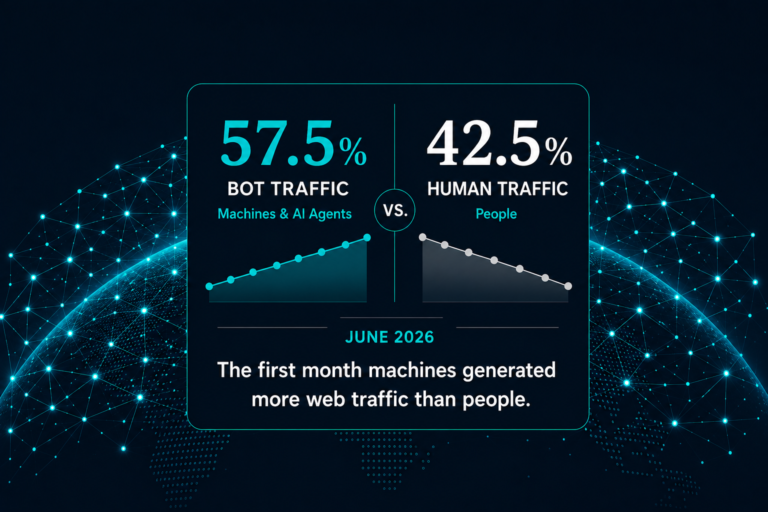
Cloudflare CEO Matthew Prince had a reasonable forecast: automated traffic would overtake human activity on the web sometime in 2027. He was wrong by more than a year. According to Cloudflare’s measurements of HTTP requests observed across its network, bots now account for approximately 57.5 per cent of traffic, leaving humans responsible for the remaining 42.5 per cent. The crossover happened in late April 2026, roughly 18 months ahead of when many industry observers expected it, and Prince acknowledged publicly that the pace of change had surprised him.

That matters because the entire commercial architecture of the internet, advertising, analytics, SEO, content publishing, was built on a single assumption: traffic means human attention. Every business model that monetises the web depends on it.

That assumption is now wrong more than half the time.

Sources: 1 2 3

Why AI Agents Changed Everything

What changed is the emergence of AI agents: software that does not just retrieve a page but completes entire workflows on behalf of a user. According to HUMAN Security, agentic AI traffic grew nearly 8,000 per cent year-on-year in 2025 alone, a figure that, even discounted for methodology, points to growth of an order of magnitude unlike anything seen in the web’s previous history. Source

Consider a straightforward example. A person researching a new laptop might visit five or six websites before deciding. An AI agent performing the same task could visit hundreds of pages in minutes, cross-referencing specifications, prices and reviews at a scale no human could match. Adobe data shows retail sites alone saw AI-sourced traffic rise nearly 400 per cent year-on-year in the first quarter of 2026. Source


Multiply that behaviour across millions of users and the arithmetic becomes stark. The agent visits a thousand pages. The human sees one answer. The websites that served those thousand pages receive no advertising impression, no subscription revenue and no meaningful engagement signal. They simply get a request, serve a response and receive nothing in return.

That is not a niche technical problem. It is a structural challenge to the way the web pays for itself.


The Industries Most Exposed

Publishers face the sharpest immediate pressure, from two directions at once.

On one side, publishers increasingly argue that AI-generated search results are reducing the need for users to click through to original sources.

Chartbeat data shows Google Search and Google Discover referral traffic fell 34 per cent and 15 per cent respectively between late 2024 and late 2025. Small publishers lost up to 60 per cent of their Google referral traffic over the same period, medium-sized publishers lost 47 per cent, and even large publishers with over 100,000 daily page views saw a 22 per cent decline.

Sources: 1 2

Some publishers have already been forced to shut down entirely. According to Bloomberg reporting cited by AdExchanger, the travel blog The Planet D, founded in 2008, ceased publication this year after losing 90 per cent of its traffic following Google’s rollout of AI Overviews. A home improvement site called Charleston Crafted lost 70 per cent of its traffic between March and May 2024, resulting in a 65 per cent fall in advertising revenue.

Source

On the other side, the bots consuming that content are simultaneously driving up the cost of serving it. AI bots often ignore standard caching protocols, forcing requests back to origin servers at far greater expense. According to Akamai, 63 per cent of recorded AI bot activity targets the publishing sector specifically. Publishers absorb those infrastructure costs while receiving no revenue in return.

Sources: 1 2

Advertising faces a version of the same problem with a longer fuse. The digital advertising industry was built around human attention because humans are the ones who buy things. Machines do not click adverts, develop brand preferences or respond to seasonal promotions. As machine-generated traffic grows as a share of overall activity, the gap between raw traffic figures and genuine commercial audiences will widen. Google Network revenue, which covers AdSense and Ad Manager, fell 4 per cent to $6.97 billion in Q1 2026, a decline some analysts have linked in part to AI-generated search experiences that reduce the volume of outbound clicks.

Source

Search engine optimisation faces a different kind of disruption. Businesses have spent years optimising content for human visitors arriving through search engines. Increasingly, AI systems are becoming the primary intermediary between users and information. The question is no longer simply how to rank well in search results. It is how to be discovered, interpreted and trusted by systems that make decisions on behalf of humans rather than by humans themselves.

What Comes Next

The near-term disruption will be quieter than the headline suggests. People will keep using browsers. Websites will keep loading. Most businesses will not notice anything different next Monday morning.

The slow-motion problem is more serious.

The web’s economic model runs on human attention. Advertisers pay for eyes, not server requests. Publishers earn revenue from readers, not crawlers. SEO exists to place content in front of people who might act on it. AI agents do none of those things. They consume content without engaging with adverts, compare products without developing loyalty and answer questions by aggregating information from sources they neither credit nor compensate.

Some publishers are beginning to respond. AI licensing deals, allowing AI companies to access content in exchange for fees rather than traffic, are emerging as one potential revenue stream. USA Today reported notable licensing revenue for the first time in Q1 2026, and People Inc. saw non-session-based revenue, which includes licensing, grow 24 per cent year-on-year in the same period.

Source

But licensing deals currently benefit only the largest publishers with the leverage to negotiate them. For the rest, the funding paradox remains unanswered. The infrastructure costs of serving machine traffic will rise. The advertising and subscription revenues that pay for content, generated almost entirely by human readers, will continue to come under pressure. Someone built every page those agents are scraping. The question nobody has answered yet is who pays them to keep doing it.

The organisations worth watching are not the ones optimising for today’s traffic figures. They are the ones asking what a web built for machines actually needs to look like, and whether the humans who built the old one can afford to build the new one.


Key Takeaways

  • According to Cloudflare’s HTTP request data, bots now account for approximately 57.5 per cent of observed web traffic, surpassing human activity earlier than many industry observers predicted.
  • AI agents, not traditional bots, are driving the shift. They complete complex tasks by visiting vast numbers of pages on behalf of users.
  • The web’s core commercial assumption, that traffic equals human attention, is becoming increasingly unreliable.
  • Publishers face a double squeeze: falling referral traffic from AI-powered search and rising infrastructure costs from bot activity, with no corresponding revenue.
  • The internet is evolving from a human-facing destination into a data layer for AI systems.
  • The unresolved question is economic: if machines are the primary audience, who funds the content they consume?


🤝 Over to you

If machines are becoming the primary users of the internet, is your digital strategy still built for a human-only web?

It is an uncomfortable question for many organisations. It is also the right one to be asking in 2026.

If you found this week’s breakdown useful, please consider forwarding it to a colleague.