
AI Agents Need House Rules
FutureShifts | Second October 2026 Edition
This edition looks at AI agents inside organisations: how widely they’re already being used, why sharing one safely across a business is harder than building it and a practical toolkit leaders can use to put some structure around them.
We’ve also rounded up 5 of the biggest AI developments since our last edition.
We hope you find it useful.
AI In Focus: Recent Developments
Google launches a single Gemini agent for work. Google has announced the Gemini agent, which takes a goal, plans the steps and returns finished work inside the documents, email and tools people already use. It picks the model for each job, currently from the Gemini and Claude families. It is in private preview, and Google says it will reach selected Workspace Business and Enterprise plans soon, without giving a date.
OpenAI starts watermarking ChatGPT text in the EU. To comply with the EU AI Act’s transparency rules, OpenAI is adding an invisible watermark to text from ChatGPT and Codex for EU users over the coming weeks. API customers anywhere can opt in. OpenAI’s own tests show that light editing weakens detection, and the detection tool is open only to approved researchers for now.
Claude now works inside Google Docs, Sheets and Slides. Anthropic has released a beta add-on for all paid Claude plans that opens Claude in a sidebar. From there it can edit documents, build formulas and charts in Sheets and create slides that follow a deck’s existing layouts. Users can approve each change or let edits apply automatically.
ChatGPT answers become more visual. OpenAI has launched Intelligent UI, which adds interactive charts, calculators and diagrams to ChatGPT responses. It reached paid plans on 7 October and Free and Go users the following day. Users can reduce how many visuals they see.
US appeals court rejects fair use for training a legal AI tool. In Thomson Reuters v. ROSS, the US Court of Appeals for the Third Circuit found that training a rival legal-research tool on Westlaw headnotes was not fair use. It is the first federal appeals ruling on fair use in AI training. The court distinguished the case from generative AI, so the wider question for tools like ChatGPT remains open.
AI Agents Need House Rules
Who builds, who owns, who pays: a practical toolkit for leaders
Building a basic AI agent is now relatively straightforward on many workplace platforms. A team can set up an agent that sorts incoming IT requests, suggests fixes from past tickets and drafts a first reply, often without writing a line of code. Deciding who can use that agent, what it can see, who pays each time it runs and who looks after it a year from now is a separate piece of work.
The survey evidence suggests that this second piece of work is not always keeping pace with adoption.
How widely agents are already being used
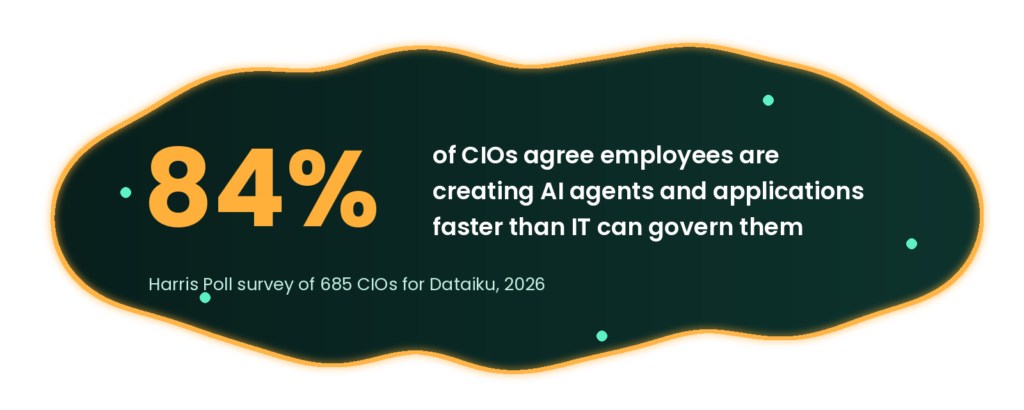
Microsoft’s 2026 Work Trend Index found that the number of active agents in Microsoft 365 grew 15 times year on year, rising to 18 times in large enterprises, and the rules for managing them have lagged behind. In a Harris Poll survey of 685 chief information officers across eight countries including the UK, carried out for Dataiku in July, 84 per cent agreed that employees are creating AI agents and applications faster than IT can govern them. A further 83 per cent said they have no standardised way of managing agents across the organisation from creation to retirement.
EY’s survey of 202 senior AI decision-makers at US companies with at least $1 billion in annual revenue, published in September, points the same way. Almost all of them (98 per cent) have formal AI governance policies, and 91 per cent are already using agentic AI in pilots or full deployment. Yet nearly half (49 per cent) haven’t updated their governance frameworks for agents, 47 per cent have skipped governance processes to push through an urgent deployment and a quarter (26 per cent) can’t detect unauthorised AI agents running inside their own organisation. So having an AI governance policy doesn’t necessarily mean an organisation knows which agents it is running.
Why sharing an agent is harder than building one
Some of the difficulty comes from the platforms themselves. Each of the major workplace AI providers now offers agents, and each has its own rules for who can build them, how they are shared and how they are paid for.
Microsoft charges for agents built in Copilot Studio in Copilot Credits, based on how much work each agent does to answer a request. Staff with a Microsoft 365 Copilot licence can use agents for common tasks, such as getting answers grounded in company content, without it counting against the meter. For colleagues without that licence, agent use can be charged, and the pay-as-you-go billing that covers it is switched off by default until an administrator turns it on.
Google’s Gemini Enterprise pools a daily allowance of queries across everyone on the same edition. Once that shared pool runs out, usage is restricted unless an administrator has enabled overage charges, which are billed at Google’s standard platform rates.
OpenAI’s workspace agents in ChatGPT can be shared with individuals, groups or the whole organisation, and administrators decide separately who can use agents, who can build them and who can publish them. OpenAI’s own help pages note that letting creators publish agents that run on their personal app connections carries data access risks.
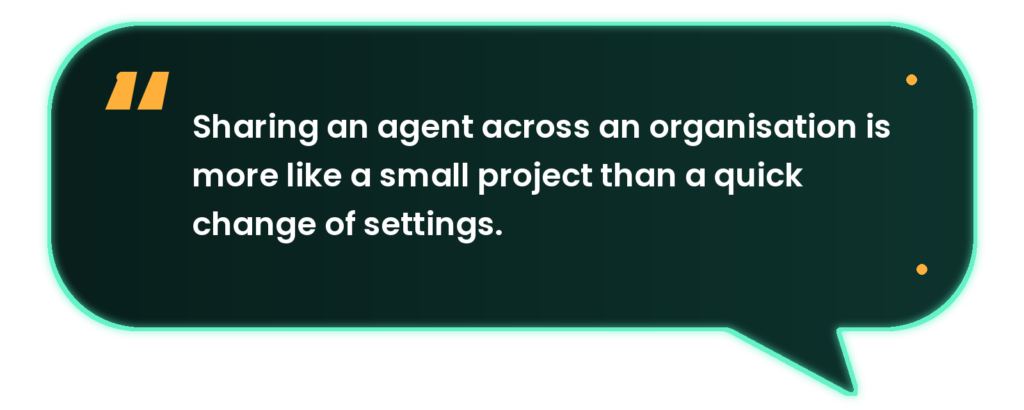
Each of these rules makes sense by itself, but taken together they mean the same agent can cost nothing extra for one colleague and be charged for the next, depending on each person’s licence and the organisation’s billing set-up. It can also be restricted once a shared allowance runs out or reach data its users shouldn’t see if it was published with the wrong connection. Getting an agent into everyone’s hands involves licensing, identity and access settings, data permissions and a budget holder, usually looked after by different people. Sharing an agent across an organisation is more like a small project than a quick change of settings, and the more platforms an organisation uses, the more of these rules someone needs to understand.
What agent governance covers
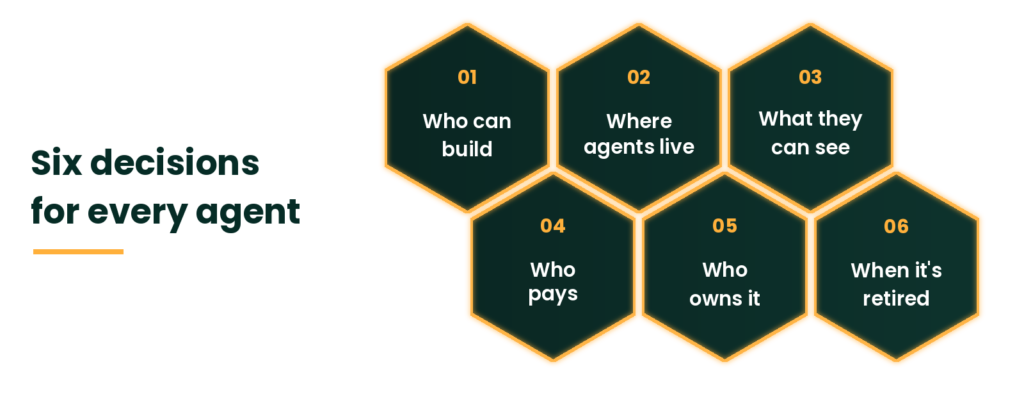
Governance doesn’t have to mean a long policy document. For each agent, it mostly comes down to a handful of practical decisions:
- Who can build. Which teams can create agents and on which platforms, and which agents can be shared more widely.
- Where agents live. One agreed home for agents and the material behind them, rather than copies scattered across personal accounts.
- What they can see. Which documents and systems an agent draws on, and whether that matches what the people using it are allowed to see.
- Who pays. A named budget holder for each agent’s running costs, and a way to see those costs by team.
- Who owns it. A named person responsible for keeping it accurate, with a date to review it.
- When it’s retired. A clear point at which an agent that is no longer used, or no longer accurate, gets switched off.
How people organise their wider AI work matters too. In Claude, for example, a project is a shared workspace that holds the documents, chats and instructions for one area of work, such as HR policies. A skill is a reusable set of instructions that shows the AI how to carry out a particular task, such as drafting a standard reply to a job applicant. Neither is an agent, but both raise the same questions. When nobody has agreed where shared knowledge is kept, which instructions everyone should reuse or who keeps them up to date, each person sets up their own. Teams then end up with overlapping versions of the same work, drawing on different copies of the same documents, with no easy way to tell which one is current.
Gartner predicts that over 40 per cent of agentic AI projects will be cancelled by the end of 2027, citing escalating costs, unclear business value and inadequate risk controls. Those concerns are a good reason to settle costs, ownership and risk controls before an agent is shared widely.
A toolkit for leaders
Leaders don’t need to become experts in every AI platform, but someone does need to set direction, and the research points the same way. Microsoft’s Work Trend Index found that organisational factors such as culture, manager support and talent practices were more than twice as strongly associated with the benefits people reported from AI as individual factors such as mindset. Microsoft is clear that this is an association rather than proof of cause. It also found that only one in four AI users say their leadership is clearly and consistently aligned on AI. EY found that 69 per cent of the companies it surveyed lack the internal expertise to evolve their AI governance controls. Many organisations are working this out at the same time, which makes agent governance as much about how an organisation is run as about the technology.
Six questions are a good place to start this quarter:
- Do we know which agents are running, who built them and what they can access? A simple register listing each agent, its owner and the data it uses makes every other decision easier.
- Is there one approved route for building and sharing an agent? People will take the easiest path available, so the approved route needs to be easy too.
- Can we see what agents cost, and by team? Only 21 per cent of the CIOs in Dataiku’s survey have full, near-real-time visibility of AI costs by business unit or use case.
- Does every shared agent have a named owner and a review date? Without one, nobody is responsible for noticing when the documents behind an agent change.
- What are people using that we haven’t approved, and why? Unapproved tools, often called shadow AI, can point to needs the approved ones aren’t meeting, which makes them useful information as well as a risk.
- How will we know an agent is worth keeping? 72 per cent of CIOs in the Dataiku survey said they can’t consistently measure whether all their agents are delivering business outcomes.
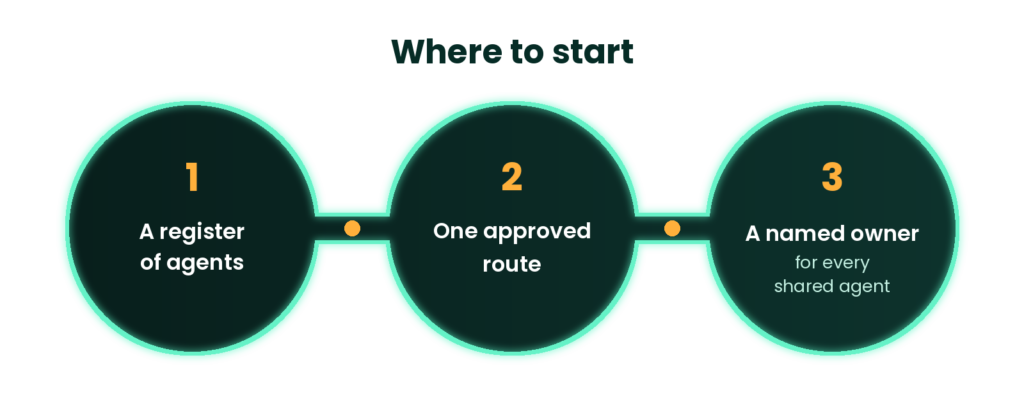
It also helps to agree who does what. One practical model is a small central group, drawing on IT, data, legal or risk and at least one business lead, that sets the standards and owns the register. Named champions in each team help colleagues build within those standards and report back on what works. Starting small is fine: a register, an approved route and a named owner for every shared agent go a long way in the early stages.
The takeaway
Agents are already being built across many organisations, whether or not anyone planned for them. The tools make building fairly simple and sharing complicated, and that gap is where unexpected costs, data risks and duplicated effort tend to appear. Closing it mostly takes clear decisions about who builds, who owns, who pays and when an agent is switched off, ideally before an agent is shared beyond the team that built it.
Over to you
If agents are starting to appear across your organisation faster than anyone can keep track of them, or you’re planning your first ones and want the structure in place from the start, I’d be glad to hear how you’re approaching it.
At GenFutures Lab we can help organisations walk through who builds, owns and pays for their agents. We also help them set up a simple register and one approved route for sharing agents, and support team champions to build within agreed standards. Our AI Adoption Diagnostic is a practical place to begin. Get in touch and we’ll talk it through.
If you found this edition useful, please consider forwarding it to a colleague.