AI is Already On Air: A New Era for Broadcasting: Music and the Humans Behind Both
FutureShifts | Second June 2026 Edition
This edition opens with our round-up of the ten most significant AI developments from the past week, covering US restrictions on frontier AI models, the KPMG hallucination episode, the race for computing power and what Reliance’s AI ambitions could mean for hundreds of millions of users.
Our main feature this week explores some of the ways AI is already reshaping broadcasting and music, how organisations are adapting to its arrival, and why the debate around AI music remains far from settled.
AI is no longer something the broadcasting and music industries are preparing for. It’s something they’re already adapting to.
AI in Focus: Recent Developments
1. US restrictions on Anthropic models unsettle allies The US government’s limits on access to advanced Anthropic models sparked a wider debate about whether one country should control access to frontier AI systems. Source
2. G7 leaders discuss trusted access to US AI models G7 leaders explored a framework for giving selected allies access to advanced US models despite tighter controls. AI has moved from a commercial issue to a matter of diplomacy and industrial strategy. Source
3. KPMG withdraws AI report after apparent hallucinations KPMG removed a report on agentic AI after several organisations disputed its claims. A striking reminder that AI-generated content can appear convincing even when the underlying information is wrong. Source
4. US energy regulator moves to speed up power for AI data centres America’s top energy regulator ordered grid operators to revisit connection rules for large power users. Advanced AI models require vast amounts of electricity and the grid is struggling to keep up. Source
5. Meta signs new AI computing deals with Crusoe Meta agreed new arrangements with data centre developer Crusoe as competition for scarce computing resources intensifies among the largest technology companies. Source
6. OpenAI adds usage analytics and spending controls for enterprise customers OpenAI introduced tools to help organisations monitor AI usage and manage costs. Enterprise AI is shifting from experimentation into managed infrastructure. Source
7. John Jumper leaves Google DeepMind for Anthropic The Nobel Prize-winning scientist behind the AlphaFold breakthrough is moving to Anthropic. One of the most significant talent shifts in AI this year. Source
8. AI data centres get a faster route to the grid US grid operators have been instructed to provide a more streamlined connection process for major data centre projects, reflecting the urgency of supporting AI infrastructure expansion. Source
9. Amazon pushes further into the AI chip market Amazon is marketing its own AI chips more aggressively through AWS, aiming to reduce reliance on Nvidia and strengthen its position in AI hardware. Source
10. Reliance wants AI embedded across India’s digital life Reliance Industries is accelerating plans to integrate AI across consumer services, communications and connected homes. At Reliance’s scale, this could bring AI to hundreds of millions of users. Source
AI Is Already On Air: A New Era for Broadcasting, Music and the Humans Behind Both
AI presenters are already here
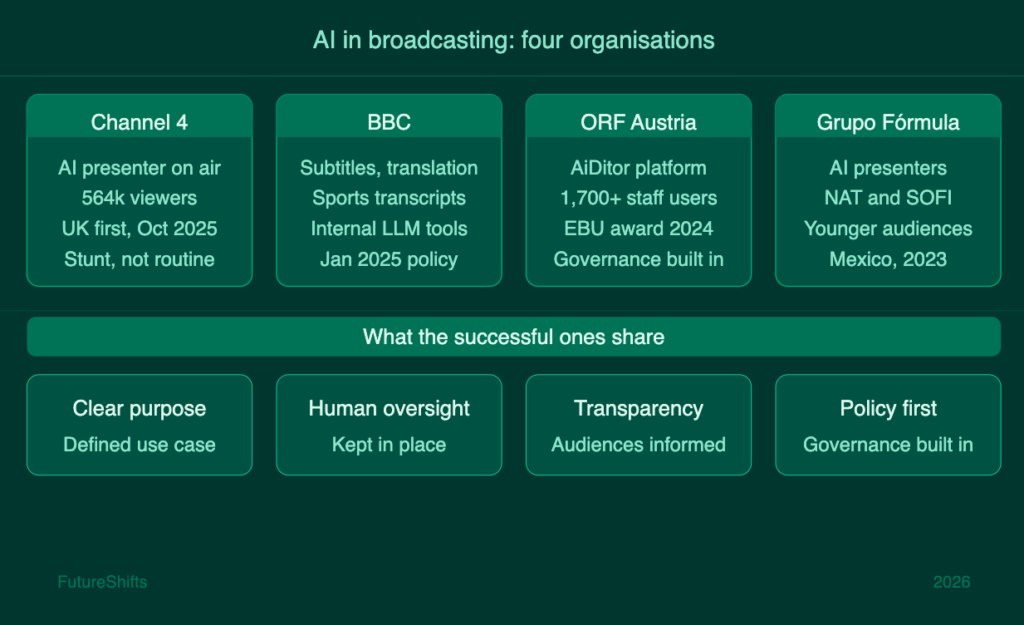
In October 2025, Channel 4 broadcast an hour-long documentary called Will AI Take My Job? The presenter, Aisha Gaban, was articulate and composed throughout. In the final moments, she told viewers she didn’t exist. Her image and voice had been generated entirely by AI, built by marketing agency Seraphinne Vallora for producer Kalel Productions. Viewers were not told until the final moments of the programme. Source
The documentary became Channel 4’s second most watched show of the day, with 564,000 viewers. Louisa Compton, Channel 4’s head of news and current affairs, later said it was “quite scary” how convincingly real Gaban had felt. She also made clear the broadcaster had no plans to make this a regular format. Human-led journalism, she said, remained the priority. Producers during filming had been unable to recreate Gaban sitting in a chair interviewing people, so her contributions were limited to pieces to camera, and her words were scripted by the production team throughout. Source
That’s worth sitting with. An AI presenter held a broadcast audience for a full hour, and most viewers only learned the truth when the programme told them at the end. That’s not a future scenario. It already happened, with real technical limitations that producers had to work around throughout.
What happens without a plan
A few weeks after the Channel 4 documentary, BBC Music Introducing West Midlands aired a pre-recorded interview with an artist named Papi Lamour. During the interview, Lamour told the presenter, Theo Johnson, that his track had been made with AI. He wrote the lyrics and directed the tools that generated the music, production and vocals. Johnson didn’t push back or ask any follow-up questions. He said it was the first time in his radio career a guest had openly said their track was AI-made, and left it there. Source
Birmingham-based artist Mollyxo formally complained to the BBC. “I’ve spent time uploading song after song to BBC Introducing, doing gigs, working with songwriters and producers and spending 20 years of my life learning how to be good at music,” she told Rolling Stone UK. “To hear someone get rewarded so quickly for something made by AI is just so disappointing.” Source
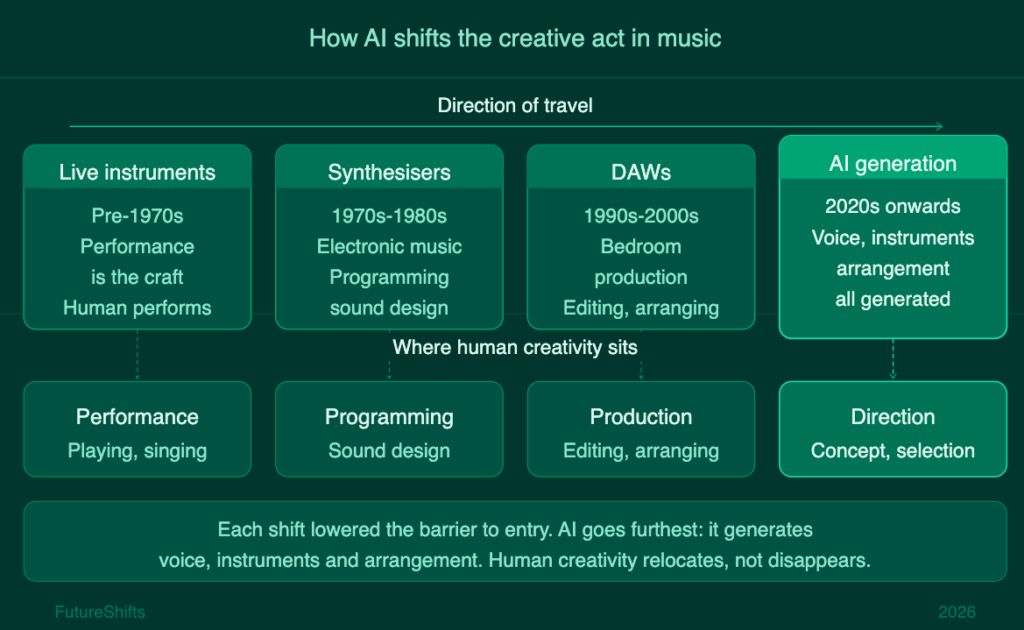
It’s a legitimate concern, but it’s also worth looking at it from a different perspective. Lamour didn’t remove human creativity from the process. He relocated it. The decisions about concept, lyrics, mood and direction were still his. What AI changed was the technical barrier between that creative intent and the finished track. That’s not entirely different from what digital audio workstations did for bedroom producers in the 1990s, or what photography did for visual storytelling: tools that lowered the barrier of entry without eliminating the human judgement behind the work.
What the incident exposed wasn’t that AI had replaced a musician. It was that music has always involved a negotiation between human performance and technology: from the synthesisers that defined electronic music in the 1970s and 1980s, to the digital audio workstations that made bedroom production possible in the 1990s. Each shift unsettled existing ideas about craft and authorship. AI is the latest version of that negotiation, but it goes further than previous tools: it can generate the voice, the instrumentation and the arrangement themselves, shifting more of the creative process from performance toward direction, selection and editing. That’s not a problem unique to music. It’s the same question organisations across every industry are facing as AI changes what creation, production and authorship look like. That question doesn’t have a settled answer yet.
How the BBC is making AI work
While those two moments were playing out publicly, the BBC had already been rolling out AI across its operations for over a year with considerably less drama.
Nations director Rhodri Talfan Davies, who chairs the corporation’s generative AI steering group, has confirmed that AI-generated subtitles are now used across BBC Sounds programmes including The Archers and The Today Podcast. AI tools also generate transcripts of English Football League and BBC Local Radio commentary, which journalists check before they are published as live text on the BBC Sport app, something the BBC says it is expanding. Translation across its Language Services has been sped up using AI, with human review throughout. Staff across the organisation are being trained on tools including Microsoft Copilot and Adobe Firefly, and the BBC’s R&D team is building its own large language models. Source
Olle Zachrison, Head of News AI at BBC News, has separately described a four-part strategy covering transcription and translation at scale, content reformatting, investigative tools and early experiments with synthetic audio and conversational news formats. Source
What the BBC has actually built is quietly substantial. Faster subtitles, quicker translation, less manual work for journalists and production teams. It also sits underneath a policy published in January 2025 that says any AI use must be disclosed to audiences and that generative AI must not be used to generate news stories or for factual research, given the risk of inaccurate or misleading output. Source
Other broadcasters are getting it right
Austria’s public broadcaster ORF offers perhaps the clearest example of what getting this right looks like in practice. In 2023 ORF built AiDitor, an in-house AI platform giving all editorial staff access to tools for transcription, translation, text editing and social media content. By mid-2024 it had more than 1,700 user accounts across the organisation, with hundreds of daily users. The European Broadcasting Union gave it their 2024 Technology and Innovation Award. What’s notable isn’t just the adoption numbers. It’s that ORF built the platform around a “human in the loop” principle from the start: AI supports the work, editorial responsibility stays with the team. The governance and the technology arrived together. Source
Grupo Fórmula, one of Mexico’s leading broadcasting groups, applies the same logic to AI presenters. Their first, NAT, was built to reach younger audiences who don’t engage with traditional newscasts. Oswaldo Aguilar Castro, the company’s director of technology and AI infrastructure, has been clear that NAT and the organisation’s other AI presenters handle specific, limited content segments and that its human presenters are not being replaced. Each news story still goes through a human verification step before it’s published. Source
Different market, different format, same principle: defined use case, specific audience gap, human oversight kept in place.
A new era that’s already here
AI isn’t arriving in broadcasting and music. It’s already there. Channel 4 proved an AI presenter can hold a primetime audience for an hour. The BBC is using AI to make its content more accessible across more languages and platforms than it could reach before. ORF gave 1,700 staff new creative tools and built the principles around them at the same time. Grupo Fórmula is experimenting with formats designed to reach audiences that traditional news formats struggle to engage. And in music, AI is producing a genuinely new category of work, not a replacement for human creativity, but a different place for it to sit.
None of this is without friction. The BBC Introducing moment showed how quickly AI can expose gaps between policy and day-to-day editorial practice. The debate around AI music is real, and the concerns of artists like Mollyxo are legitimate. But these are also the kinds of questions that accompany every major shift in creative production: the same ones that arrived with digital audio workstations, streaming and the internet itself.
What’s emerging isn’t AI as a tool bolted onto existing workflows. In music it’s producing something genuinely new. In journalism and broadcasting it’s changing how work gets done at scale. The change isn’t coming. It’s here.
🤝 Over to you
Broadcasting and music are two very different industries asking the same question: when AI changes what creation looks like, what do you stand for and what do you do when it shows up unexpectedly?
It’s worth asking that question about your own organisation before the moment arrives.
If you found this edition useful, please consider forwarding it to a colleague.