
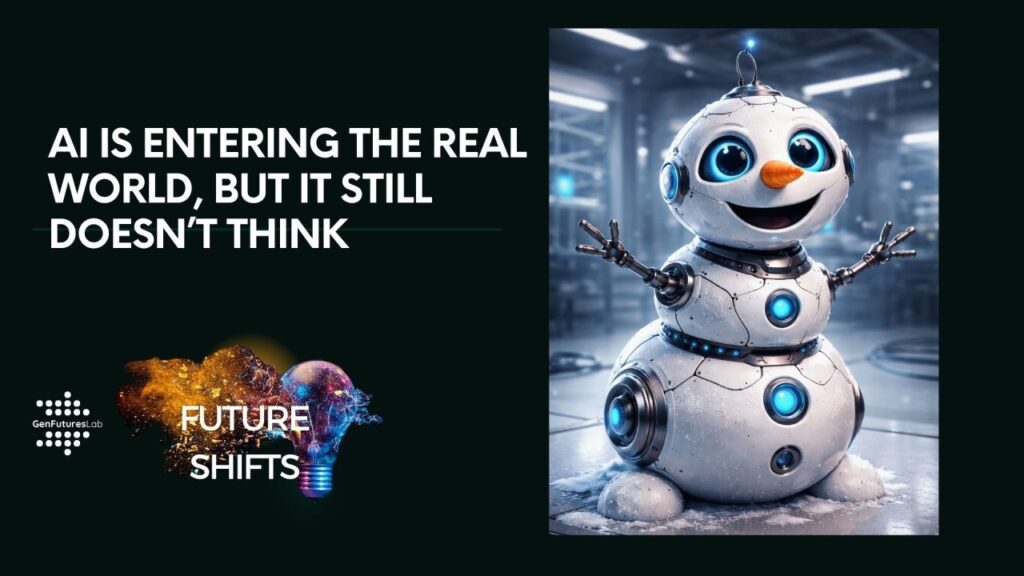
“Just like we generate electricity, we’re now going to be generating AI,” said Jensen Huang at Computex 2025, highlighting a shift from AI as software to AI embedded directly in the real world.
This week we explore:
Key AI Developments
☁️ Amazon and Nvidia power cloud AI at scale: Nvidia is supplying one million GPUs to Amazon Web Services by 2027. Source
📱 Amazon’s smartphone return: Amazon is developing a new phone, codenamed Transformer, designed to integrate closely with Alexa and cloud services. Source
💰 Big AI investments continue: Meta and Xiaomi are expanding large-scale investments across AI infrastructure and research. Source
🏢 Enterprise adoption grows: Companies such as Roche are expanding AI-enabled computing, moving from experimentation toward operational use. Source
🎤 Nvidia GTC signals AI as infrastructure: At Nvidia’s GTC, often described as the “Woodstock of AI”, industry leaders highlighted how AI is increasingly being treated as core infrastructure. Source
Companies building large-scale AI systems, including models like ChatGPT and Grok, rely heavily on Nvidia’s platforms to train and operate at scale. This reflects a broader shift, described by Jensen Huang, toward AI being integrated into operational systems, evolving into “AI factories” that convert data and compute into continuous outputs such as predictions, content and decisions. Source
🏭 Jeff Bezos and Project Prometheus: Jeff Bezos is applying AI to industrial and manufacturing processes through Project Prometheus, using simulation and predictive models to improve engineering, production and supply chains.
This approach enables virtual testing, cost reduction, faster development and improved product quality, while cloud platforms make these capabilities more accessible. Source
What is still missing: Yann LeCun argues that “true intelligence” requires memory, planning and reasoning, positioning these as key elements beyond today’s large language models.
From Simulation to Real-World Intelligence: How Human-Like is AI Today and How Far Can It Go?
AI is moving well beyond software and into the physical world. At NVIDIA GTC 2026, one of the most talked‑about demonstrations was Disney’s Olaf robot, a character capable of perceiving, moving and interacting with people in real time using NVIDIA’s full AI platform.
Olaf’s performance showed how simulation, sensors and physics‑based control can give machines the ability to perceive, react and adapt instantly. This kind of physics‑grounded AI is central to what Huang calls embodied intelligence, systems that learn through continuous interaction between the virtual and physical worlds.
The same principles now power industrial robotics, factory automation, logistics and service operations, where simulation helps predict and optimise outcomes before they happen.
At the same event, Jensen Huang outlined a vision of AI factories: large infrastructures where AI systems are trained, deployed and refined continuously. This approach suggests an evolution in how AI systems are developed: from isolated models to scalable, continuously improving systems
LeCun’s AMI Labs has raised $1.03 billion to advance world models: AI that simulates environments and reasons about cause and effect, rather than merely predicting patterns. Unlike LLMs, which generate text or code but often “hallucinate” due to a lack of grounded understanding, world-model AI plans, predicts outcomes, and reasons robustly, representing a potential path toward the next level of general intelligence.
“Current AI systems are very limited. Human‑level AI is not just around the corner, and might not be achievable in the form people imagine.”
Yann LeCun, interview with Bloomberg (December 2025)
LeCun argues that intelligence exists on a spectrum and that AI is more likely to complement rather than replicate human reasoning.
If the paths of reactive, simulation-driven AI and predictive, reasoning-based AI begin to converge, they could enable systems that respond in real time, learn from experience and begin to anticipate aspects of the environments they operate in.
In simpler terms, this points toward the possibility of systems that can better interpret context, purpose and cause and effect, an important step for applying AI more safely and effectively in real-world settings. Source
🌍The Bigger Picture
⚡ AI as infrastructure: AI is increasingly being treated as foundational infrastructure, combining compute, data and models into systems that can support continuous decision-making and operations.
🔓 Open innovation remains important: Open platforms continue to enable experimentation, allowing smaller teams to build and test AI solutions without owning large-scale infrastructure.
🧠 Emerging directions in AI: While LLMs dominate today, research into approaches such as world models suggests a possible evolution toward systems with stronger reasoning and contextual understanding, though this remains early-stage.
⚙️ Practical impact is already visible: AI is already improving operations, product design and decision-making across industries, offering tangible value even without fully autonomous systems.
Key Takeaways for Businesses
🎯 Leadership Implications
🔓 Simulation is becoming accessible Tools that were once limited to large manufacturers, such as testing designs or workflows virtually, are increasingly available through software and AI platforms.
You can now: Test product ideas before building them, Optimise operations without disruption
🧪 Use simulation to reduce risk Testing ideas virtually can improve outcomes before committing real-world resources.
⚙️ Prioritise efficiency and application The most immediate value comes from improving operations, workflows and decision-making.
🤖 Adopt autonomous capabilities thoughtfully AI is beginning to move from advisory roles toward execution, requiring appropriate oversight.
🔍 Final Thought
The competitive advantage will not come from using AI in isolation, but from:
- Applying it effectively
- Integrating it into operations
- Continuously improving how it is used
👉How could your business use AI to test ideas, optimise operations or improve product design, even if you don’t have the resources of a Tesla or Amazon?
If you would like to explore how to use AI to test ideas, streamline your operations and unlock efficiencies, get in touch. We can run a FREE mini-discovery to help identify where AI can truly move the dial for your business.