
What are Ambient Agents?
Ambient agents are built to sense and respond to events rather than prompts. They are inspired by “ambient intelligence,” the idea that technology should blend into our environment and anticipate needs.
Instead of living in a chat window, they monitor signals such as system logs, emails, calendars, or IoT data. They decide what action is needed and either do it directly, like opening a ticket or scheduling a task, or escalate to a human when the stakes are high. The aim is to reduce unnecessary interruptions and free people to focus on the decisions that matter.
Where They Are Being Used
Apple’s “on-screen awareness” features, announced this year, are a consumer-facing example. The phone notices what is on your screen and offers to act on it, such as saving an address or creating a reminder, without you needing to copy and paste.
A relatable way to think about this is through the connected home. Imagine a set of sensors in your house linked to an ambient agent. Instead of you asking it to turn the heating down or check if the front door is locked, the agent notices the temperature has risen or that the door has been left ajar and acts on its own.
Recent months have shown concrete examples of ambient agents in action:
- Enterprise IT – Systems that detect outages, create tickets, and run diagnostics before escalating to engineers.
- Customer operations – Agents that monitor product usage, flag churn risks, and draft outreach emails automatically.
- IoT and facilities – Vision-based agents that detect faults on equipment and schedule repairs.
- Personal productivity – Assistants that triage inboxes or prepare meeting notes by scanning calendars and documents.
Key Characteristics
Ambient agents share a set of qualities that make them different from traditional assistants. These traits explain how they can run in the background, adapt to context, and step in only when human attention is needed:
- Autonomous and proactive: They run continuously, triggered by events and not by typed commands.
- Context aware: They use memory and multi-stream inputs to adapt, whether that’s reading from APIs, workflows, or telemetry.
- Human-in-the-loop: They ask for approval when an action is ambiguous or high risk, keeping accountability in place.
- Multi-agent collaboration: Several ambient agents can work together, for example monitoring different parts of an IT system or supply chain.
- Invisible until needed: They step forward only when human attention is required.
How They Differ from Other Agents
To understand why ambient agents matter, it helps to compare them with other types of digital agents. The table below highlights the main differences in how they are triggered, how they operate, and the role humans play.
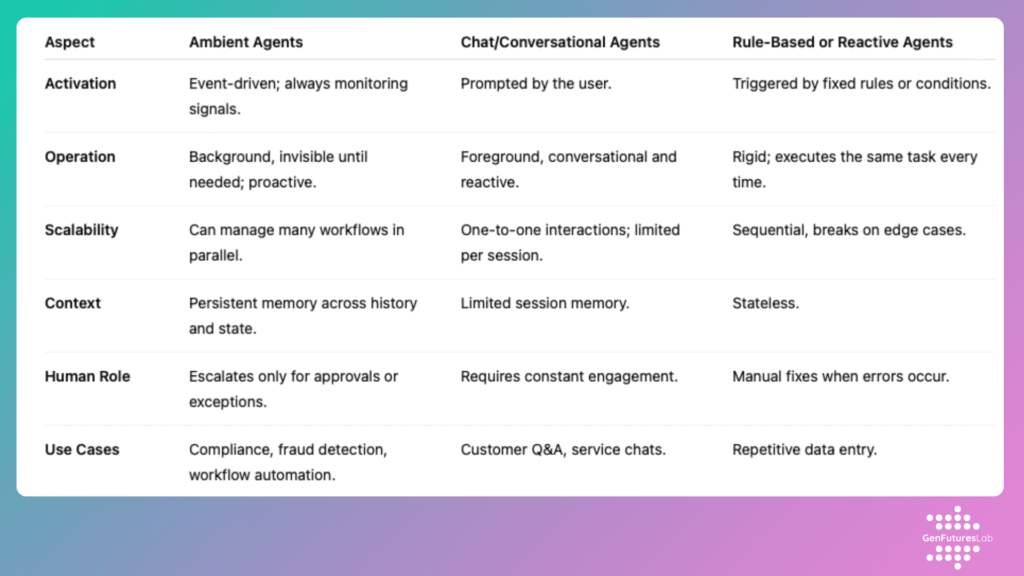
This comparison shows why ambient agents are seen as a step change: they reduce interaction overhead and scale across whole organisations.
Why This Matters
The rise of ambient agents is about more than efficiency. It changes the relationship between people and digital systems. Work that once required attention and constant prompting now moves forward on its own, with humans in control of the final calls. For businesses, this means faster response times, better use of staff capacity, and less risk of errors slipping through the cracks.
Closing Thought
Most digital agents today are still reactive, answering one question at a time. Ambient agents point to a different future—one where intelligent systems act as background teammates, handling the routine while surfacing only what truly needs your input.
GenFutures Lab helps organisations navigate AI adoption with clarity, compliance, and creativity. Need tailored training, benchmarking, or policy guidance? Contact us to get started: https://genfutures.co.uk/contact-us/
