
From Pilots To Production In Sport
FutureShifts | First October 2026 Edition
Notes from SportsPro AI + Tech 2026, London Stadium
This edition is a little different. Last week our team spent two days at SportsPro AI + Tech at London Stadium, and everything you’ll read here comes from that event: the panel I moderated, the talks we attended and the conversations we had between sessions. We’ve left out our usual roundup of AI developments this time so the event gets the space it deserves.
When I wrote about SportsPro Madrid in November 2024, much of the conversation was about what AI could do for advertising, production and fan experiences. This year, clubs, leagues, broadcasters and event organisers spent far more time on what it takes to get AI used, trusted and scaled.
Happy reading.
Adoption at the point of trust: my panel
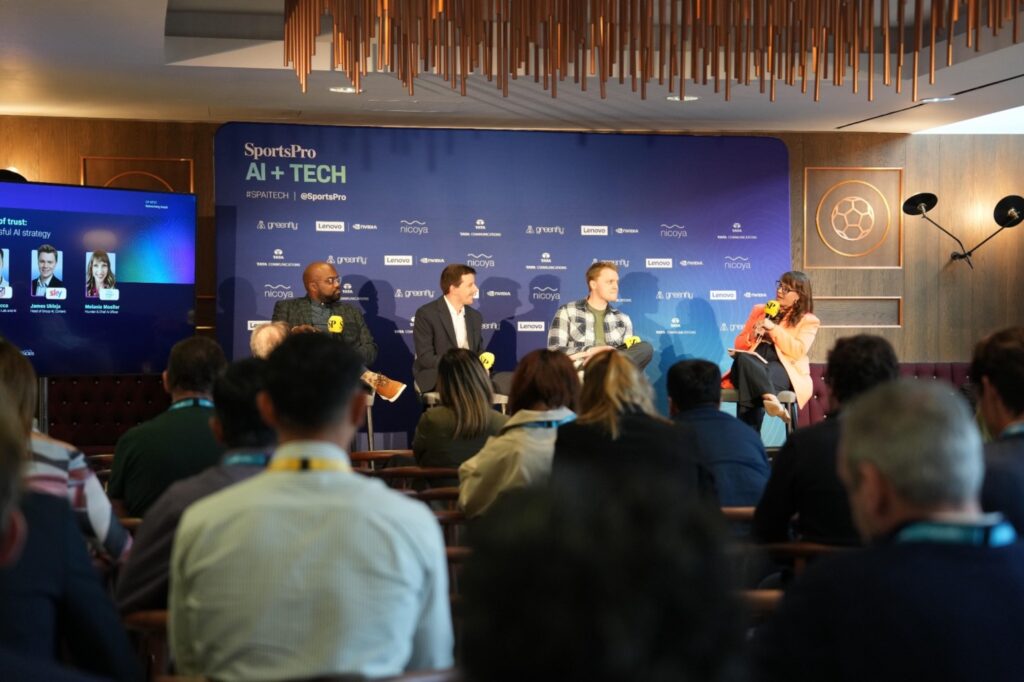
On the first afternoon I moderated a panel on building an AI strategy people trust, with Rich Bowman (NASCAR), James Ukleja (Sky Group) and Gabriel Cocca (Atlético de Madrid). Here are the points that stood out.
- Meet people where they are (Rich Bowman): Workshops alone didn’t change habits. People came, said they would use AI and went back to their old way of working the next day. What worked was joining finance, HR and communications team meetings, asking which tasks nobody wanted to do and showing how AI could help with that work today. The sceptics who became fans then spread AI around NASCAR better than he could.
- Test the format before scaling it (James Ukleja): Sky trialled Moments, the vertical video feed in the Sky Sports app, for a full season before launching it. AI made producing that volume of clips more cost-effective, and A/B testing showed engagement went up. With thousands of clips, not every one can be reviewed as before, so quality has to be managed differently.
- Use AI where the budget would otherwise rule an idea out (James Ukleja): For The Wargame, the Sky News podcast that has become a TV series, AI was used to create reconstructions of explosions in central London, warships and missile fire that an unscripted budget couldn’t have covered with traditional visual effects. The AI footage was clearly labelled as fictional.
- Bring everyone along (James Ukleja): Senior leaders were shown what AI tools can do in practice, while everyone at Sky was given access to an AI tool, tiered training from bronze to gold and the chance to enter a company-wide pitching competition. James said 90% of teams now use AI, with more than half using it daily.
- Pilot small and build only what’s core (Gabriel Cocca): Atlético’s AI 360 programme covers experimentation, training, measurement and governance. The club buys from suppliers to test ideas quickly and builds only when something is core and recurring, such as an internal agent for audience segmentation requests, with a person checking the output.
- Train by role (Gabriel Cocca): After a general course for everyone, frontline staff and leaders follow separate tracks. Last year 24 employees took part in an AI-focused innovation programme with a university partner and pitched ideas to directors. Two are being taken forward this season.
- Let governance keep innovation moving (Gabriel Cocca): He described innovation as the train and governance as the track. Because the club had agreed a risk-based framework with legal and procurement, its communications and social media teams were already prepared when new AI labelling rules arrived.
- Match review to risk (Rich Bowman): A meeting-prep assistant and a public-facing agent answering fans’ questions shouldn’t go through the same checks. As autonomy goes up, review should become stricter and the road to approval longer. A human in the loop who isn’t really reviewing anything amounts to tacit consent, so at NASCAR someone other than the builder checks each system.
Insights from other talks and panels
Stuart Fenton, Head of AI, Reading FC
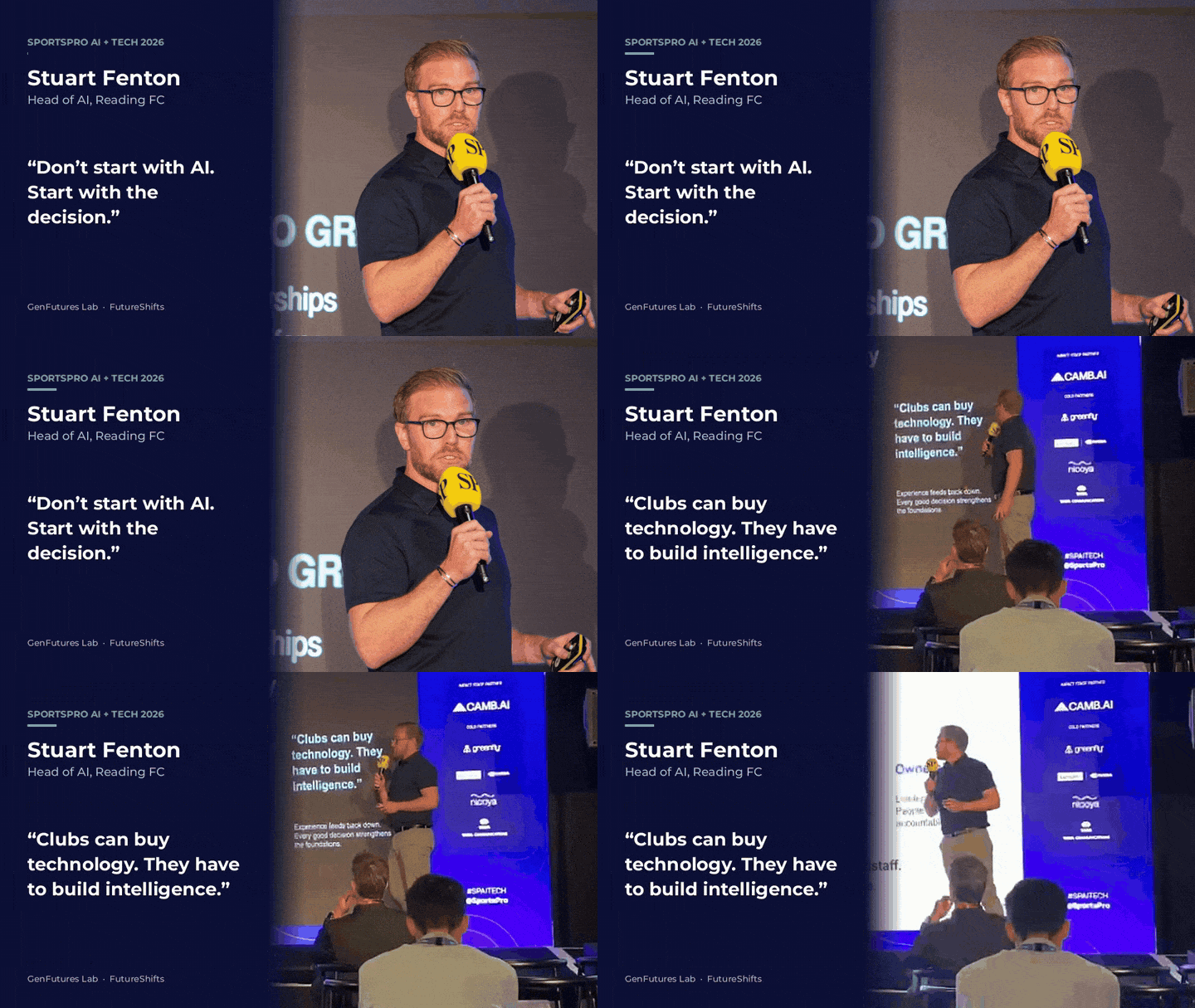
Stuart Fenton is the first Head of AI at an English football club. When he joined, the starting point was what the club wanted to achieve. Data and partners came next and the technology came last. AI only works if people use it and trust it, and he was clear that “football doesn’t have a data problem, it has a time problem”: staff need to understand information quickly and act on it. His test of success is whether an insight changes what the club does, and whether the club gets smarter every season. As he put it: “You can buy the technology, but you have to build the intelligence.”
Bhavesh Vaghela, Chief Product and Technology Officer, London Marathon Events
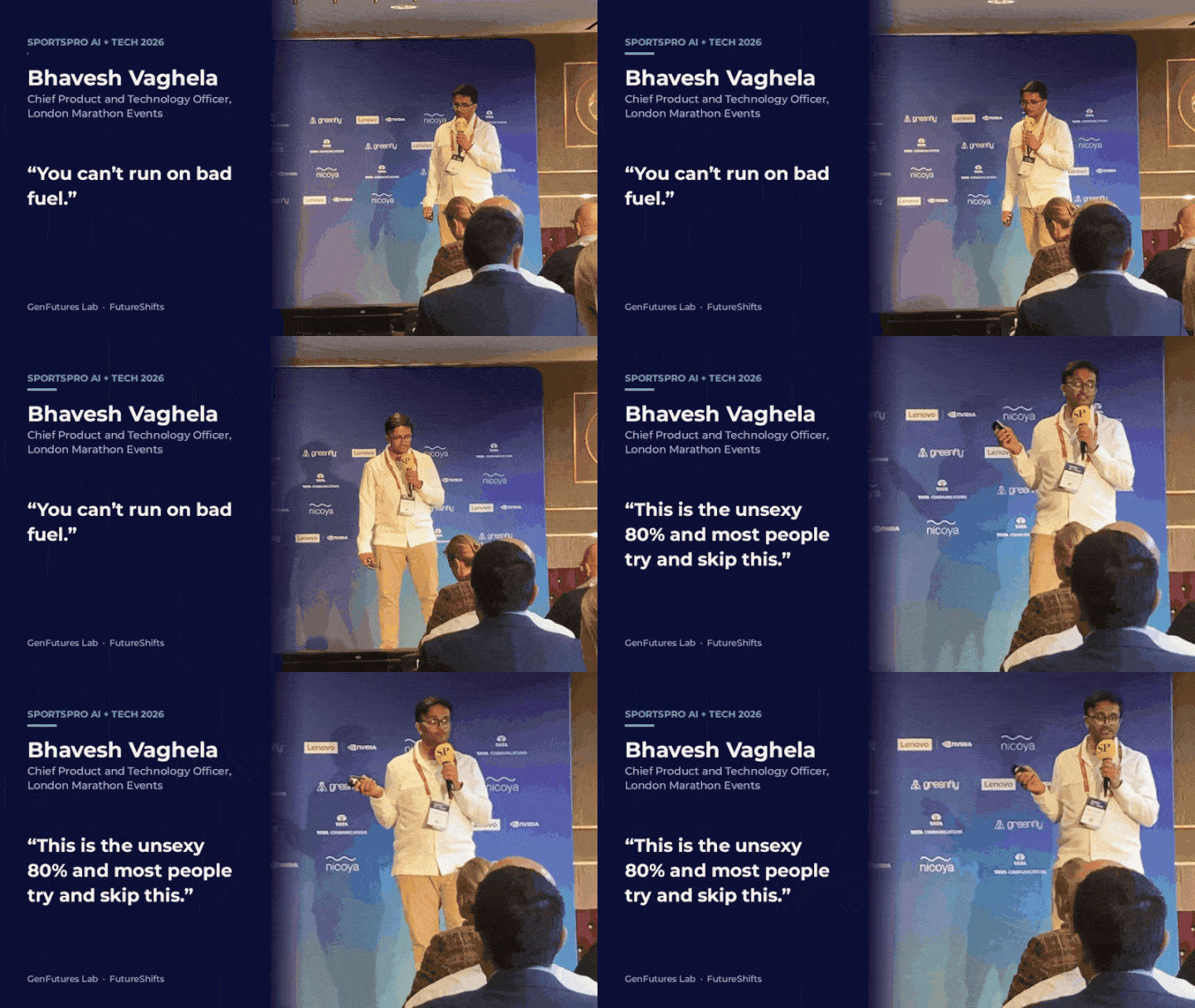
Bhavesh Vaghela opened with a figure from his slides: 82% of organisations say they have adopted AI, but only 5% say they are winning with it. He compared many AI programmes to runners who set off too fast at the start of a race, with a big vendor contract, rushed pilots, no clear problem or return on investment and no training for the team. Failed pilots end up in a “silent graveyard” where nobody learns from them. The 5%, he said, focus on fuel, form and fitness: clean data, the right governance and skilled people. London Marathon Events spent four years on its data before AI took off, which keeps hallucinations limited. His advice for anyone without that head start was to pick a use case, clean the data it needs and prove the return.
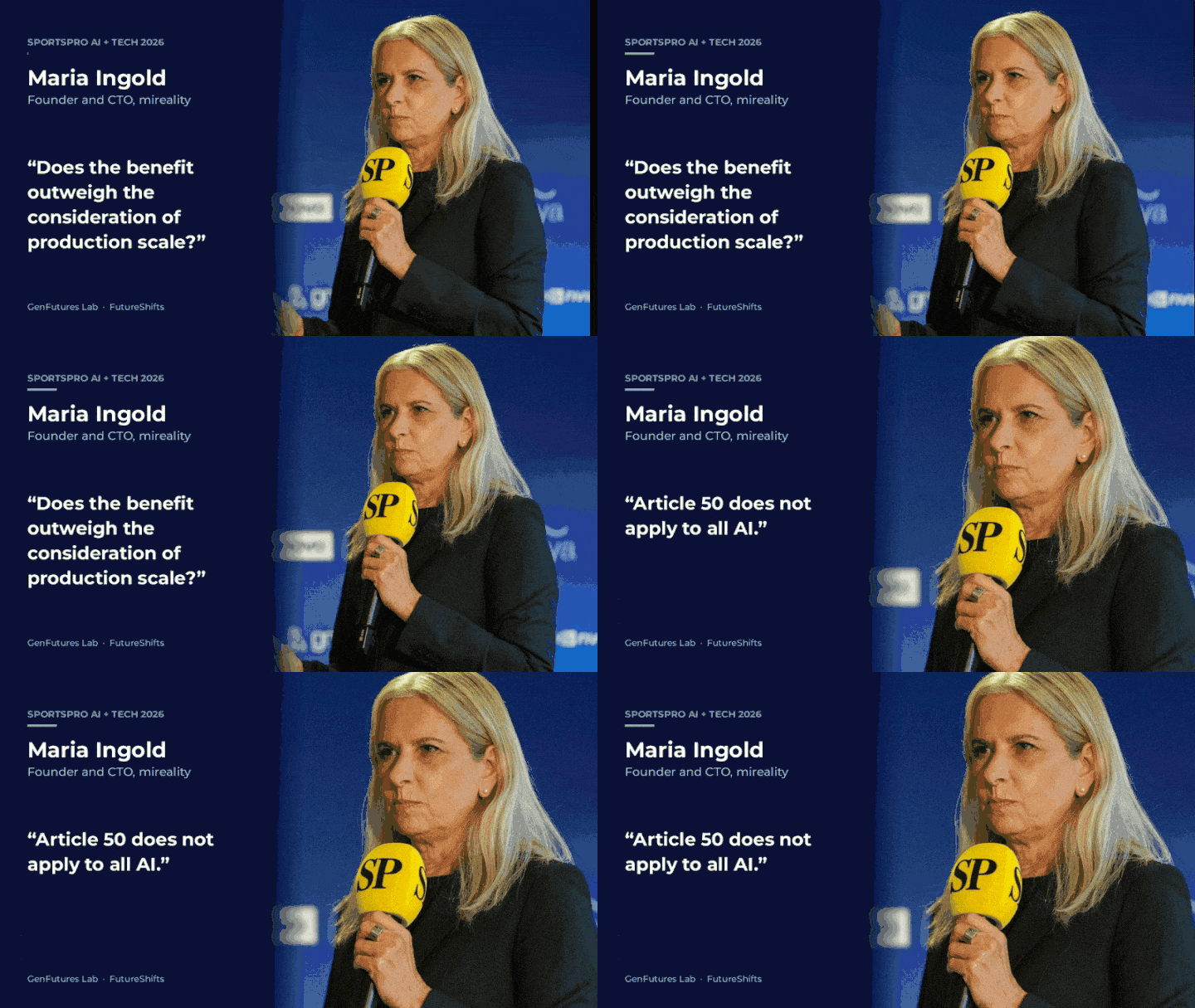
Maria Ingold, Founder and CTO, mireality
Maria Ingold asked whether the benefit of an AI pilot still outweighs everything it takes to run it at production scale. Before scaling, she suggested checking five things: data (can you trust the inputs?), outputs (are they accurate?), people (are they trained and is someone responsible?), economics (what happens at a million uses rather than one?) and governance (who is accountable?). She also explained Article 50 of the EU AI Act, which has applied since 2 August and sets transparency duties for direct interaction with AI systems, emotion recognition and biometric categorisation, synthetic content and deepfakes. Her key point was that it does not apply to all AI. Transcription, text translation and recommender systems don’t necessarily trigger it, while cloning a commentator’s voice for dubbing could.
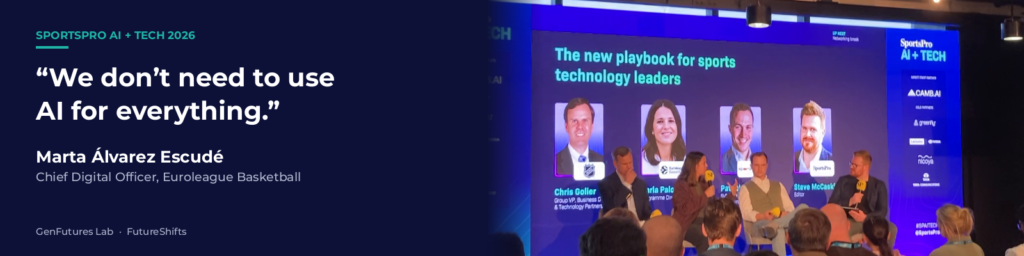
Marta Álvarez Escudé, Chief Digital Officer, Euroleague Basketball
Technology on show
JaionX
JaionX is Aimbroad’s football app, and four of its team talked us through it.
- Michael Jang, CEO and Founder, speaking in Korean, said a result tells you who won but not why, and for him the answer usually lies in teamwork. Their football AI turns teamwork in matches into an index.
- A colleague summed up the approach: “We’re crazy about teamwork. We’re crazy about indexing everything. Our world is full of index.”
- Michaela Wilson showed the post-match review. The JaionX score is a teamwork index built from analysis of more than 10,000 matches, combining attacking structure, tactical execution and finishing efficiency, and tracked across the 90 minutes against an AI-generated “win line”.
- Juho Hahn demonstrated Vibe Football, which is not yet commercially available. You ask a question by typing or speaking and get the data, an infographic and an interpretation together.
CaptionHub
Grant Williams, Sales Director, described CaptionHub as a multimedia localisation platform used by tier one broadcasters, sports organisations and enterprise clients to reach wider audiences and open up revenue in new markets.
Aura, WPP
One of the more unexpected introductions was Aura, WPP’s humanoid robot, built on a robot called G1. Eunah Lee from WPP told us the team was there to show how the group is using robotics in advertising. WPP has been exploring how robotics and physical AI could play a part in creative and content production. There are still open questions about where robots like Aura will prove useful, but seeing one in action made physical AI feel a lot less theoretical.
The takeaway
The organisations at SportsPro AI + Tech could hardly be more different, from a League One club to a motorsport series, a basketball league and the team behind the London Marathon. The same lessons kept coming up. Start with the problem or decision and choose the technology afterwards. Build trust and skills by working alongside people rather than relying on a single training course. Judge AI by whether it changes what people do, and match governance to risk. We also saw AI making things possible that budgets would not otherwise allow, from The Wargame’s reconstructions to content localised for new markets and teamwork data for clubs.
Over to you
If you are working out how to move AI from pilots into everyday work, I’d love to hear what is working for you and what isn’t. At GenFutures Lab we help organisations do exactly this, and our AI Adoption Diagnostic is a practical place to start. Get in touch.
If you found this edition useful, please consider forwarding it to a colleague.
At GenFutures Lab, we’re trying to get the most out of AI while using it as efficiently as we can, and we take environmental responsibility seriously in how we work. If any of this raises questions for your own use of AI, get in touch. We’re always happy to talk it through.
If you found this edition useful, please consider forwarding it to a colleague.