
How Disney Uses AI: Lessons for Businesses
FutureShifts | First July 2026 Edition
This edition opens with our round-up of the ten most significant AI developments from the past week.
Our main feature explores how Disney is applying artificial intelligence across different parts of its business, from animation and customer engagement to operations and creative production. Rather than relying on a single AI solution, Disney applies different technologies to different business challenges, offering practical lessons for organisations looking to adopt AI effectively.
Whether you’re exploring AI for the first time or looking to expand its use within your organisation, Disney’s approach demonstrates why successful AI adoption begins with understanding the business problem before selecting the technology.
AI in Focus: Recent Developments
1. Rising AI bills push firms toward cheaper Chinese models as performance gap narrows
Soaring AI bills are pushing companies to favour cheaper models over marginal gains in performance according to Reuters reporting cited in this piece. The shift has sparked a wider pricing battle in which Chinese models are also closing the performance gap with leading US systems in specialised fields such as cybersecurity. Source
2. Meta says progress on AI agents has been slower than expected
Meta’s Chief Executive Mark Zuckerberg told staff at an internal town hall that AI agent development had not accelerated as expected over the prior four months and that the company’s restructuring had not been as clean as intended. Source
3. Microsoft launches $2.5 billion Frontier Company for enterprise AI deployment
Microsoft announced a new operating business called Microsoft Frontier Company backed by a $2.5 billion investment and around 6,000 embedded engineers to help enterprises deploy and integrate AI systems from multiple providers. Source
4. Alibaba, Tencent and Baidu back $2.8 billion Kling AI funding round
Kuaishou’s Kling AI video unit secured over $2.8 billion from investors including Alibaba, Tencent and Baidu, valuing the business at $15 billion before the investment and diluting Kuaishou’s stake to about 68 percent. Source
5. Alibaba bans Claude Code after alleged hidden tracking code is discovered
Alibaba has told staff to stop using Anthropic’s Claude Code from 10 July, classifying it as high-risk software after security researchers found code that could secretly identify whether a user was based in China. The ban lands amid a wider dispute in which Anthropic has accused operators linked to Alibaba’s Qwen lab of large-scale distillation of Claude’s outputs, an allegation Alibaba denies. Source
6. Amazon closes Mechanical Turk to new customers
Amazon will stop accepting new customers for Mechanical Turk from 30 July, though existing users are unaffected. The long-standing crowdsourcing platform, once central to AI data labelling, has been overtaken by Amazon’s own automated tools such as SageMaker Ground Truth. Source
7. Midjourney seeks to force Hollywood studios to disclose their own AI use
In its copyright litigation with Disney, Universal and Warner Bros, Midjourney has asked a federal court to overturn a ruling limiting discovery, arguing the studios should have to disclose their own internal AI training practices. Midjourney contends this evidence would support its fair use and unclean hands defences. Source
8. OpenAI proposes giving the US government a 5 percent equity stake
OpenAI has reportedly floated handing Washington a five percent stake in the company as part of a proposed public wealth fund modelled on Alaska’s oil dividend scheme, with chief executive Sam Altman framing it as a way to let ordinary Americans share in AI’s financial upside. The idea remains at an early, conceptual stage and would likely need congressional approval, and it is not yet clear whether rivals such as Anthropic or Google would agree to similar arrangements. Source
9. Google’s AI expansion drives record 37 percent jump in electricity use
Google’s latest environmental report shows its electricity consumption climbed 37 percent in 2025, the steepest annual rise in the company’s history, driven by AI data centre growth. The company still matched its entire electricity use with renewable energy purchases but admitted its long-term climate targets are becoming harder to hit. Source
10. Tesla caps employee AI spending at $200 a week, exempting its own AI tools
Tesla has told staff it will limit third-party AI tool spending to $200 per person per week from 6 July, after some engineers ran up bills worth thousands of dollars weekly. Beta versions of its own xAI tools are excluded from the cap, even though reports suggest many Tesla engineers actually favour Anthropic’s Claude over Musk’s Grok. Source
Disney applies AI across animation, marketing, operations and customer support. This newsletter examines how those applications work and what other organisations can learn from them.
When people think about AI at Disney, they often associate it with animation, filmmaking and visual effects. However, Disney’s use of AI extends beyond creative production into marketing, operations, customer support and guest experience.
Rather than relying on a single AI solution for every use case, Disney applies different AI technologies across its organisation to address specific business needs. Its approach demonstrates how AI can support a wide range of functions while remaining focused on solving clearly defined challenges.
The same principle applies when advising clients. Before recommending AI tools, it helps to understand the industry they work in and the business challenge they are trying to address. The right AI solution depends far more on the problem than on the technology.
AI in Animation
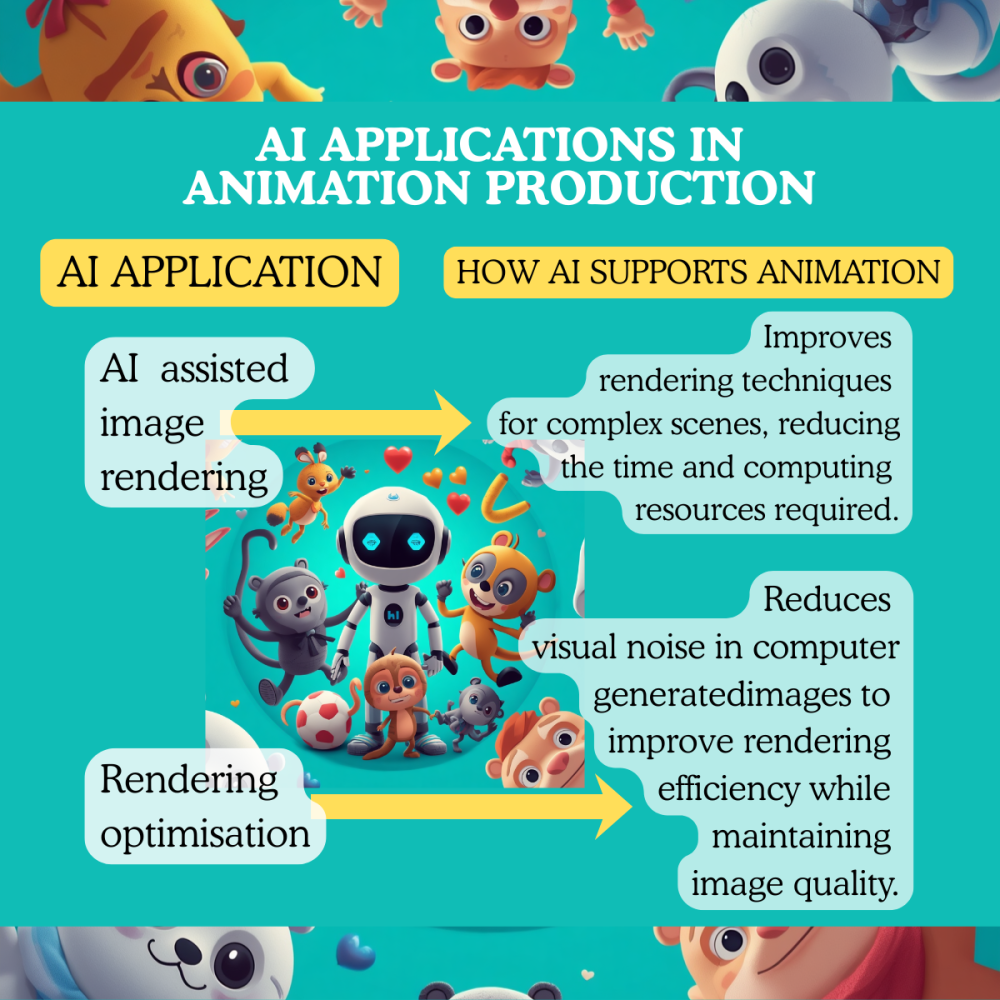
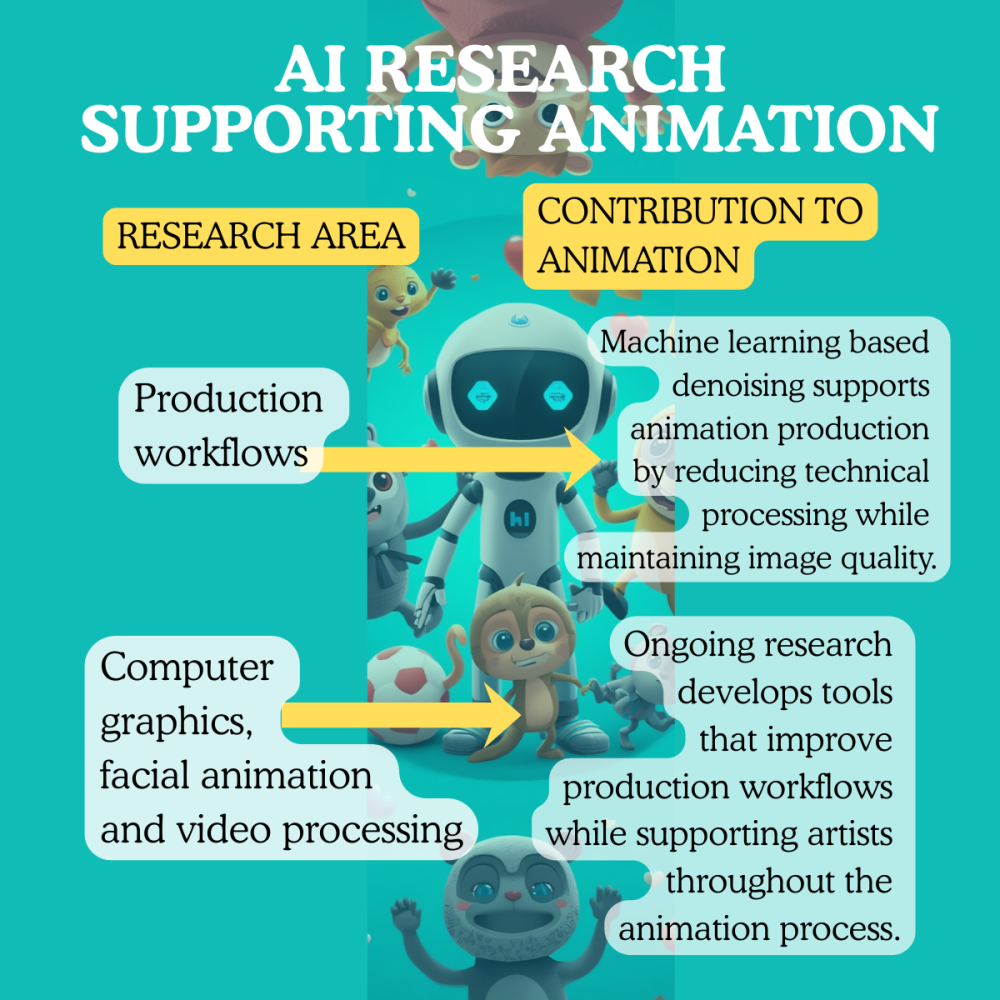
Artificial intelligence supports several technical stages of Disney’s animation production while leaving creative decisions in the hands of artists and filmmakers. One of its most established applications is AI assisted rendering, where deep learning models reduce visual noise in computer generated images. This helps produce high quality images more efficiently while preserving fine detail and reducing the time required to render complex scenes.
Disney Research has developed these techniques in collaboration with Pixar Animation Studios and has published examples showing their use in animation production. These methods help artists spend less time waiting for rendered images and more time refining the visual quality of a film. Published research demonstrates that machine learning can improve rendering efficiency while maintaining image quality required for feature animation.
Alongside rendering, Disney Research continues to investigate AI applications in computer graphics, facial animation and video processing. These technologies improve production workflows by reducing repetitive technical tasks, supporting image processing and providing animators with more efficient tools while maintaining creative control throughout the animation process.
Marketing and Customer Engagement
One area where Disney applies AI is customer engagement.
Disney continues to invest in personalisation across its streaming platforms. In its FY2026 Executive Commentary, the company said it is improving the Disney+ recommendation engine and exploring opportunities to use AI to increase personalisation. Disney also highlighted ongoing product enhancements, including a redesigned homepage and a dedicated “For You” section, as part of its efforts to improve the user experience.
During the FY2026 second quarter earnings call, Disney stated that it is developing a hyper personalised recommendation engine across Disney+ and ESPN. The company also said it is implementing AI to improve advertising capabilities, allowing advertisers to create more dynamic and targeted campaigns. These initiatives form part of Disney’s broader strategy to make its streaming services more personalised and engaging.
Disney is also applying AI within its retail operations. In June 2026, the company launched a Store Personal Shopping Assistant that allows customers to describe what they are looking for using natural language and receive tailored product recommendations from Disney’s online catalogue.
Operations
Disney also applies AI to support operational planning across its theme parks.
Managing large theme parks requires continuous decisions about staffing, guest flow and resource allocation. During Disney’s FY2026 second quarter earnings call, Chief Financial Officer Hugh Johnston described an initiative to implement precision labour demand forecasting across Disney’s theme parks. The system is intended to help managers schedule cast members based on predicted attendance levels and expected demand across individual attractions. Johnston said the objective is to improve the guest experience, support employees and manage labour costs more effectively.
Some of Disney’s AI initiatives also extend into robotics. Disney Research is collaborating with NVIDIA and Google DeepMind to develop Newton, an open source physics engine designed to improve how robots learn and move in simulated environments. Disney Research plans to use Newton to advance its robotic character platform, including the Star Wars inspired BDX droids that interact with guests in Disney parks. Training robots in simulation allows engineers to test and refine movements before they are deployed in real world settings.
Creative Production
Creative production presents different considerations for AI adoption because it involves intellectual property, copyright and creative ownership.
In December 2025, Disney and OpenAI announced a three year licensing agreement covering the use of more than 200 characters from Disney, Marvel, Pixar and Star Wars in Sora and ChatGPT Images. Alongside the agreement, Disney said it planned to become an OpenAI customer, using the company’s technology to develop new products, tools and experiences while deploying ChatGPT for employees. The companies also said the partnership reflected shared principles for the responsible use of AI, with protections for users and the rights of creators.
Those plans changed in March 2026, when OpenAI announced it would discontinue the standalone Sora application. Disney confirmed the partnership would not proceed, and Reuters and other reporting indicated that the transaction never closed and no money changed hands. Disney has continued to emphasise that it is exploring AI while protecting its intellectual property and the rights of creators.
Disney is also applying generative AI to support design work within Walt Disney Imagineering. In June 2026, Adobe and Disney announced a collaboration to introduce Adobe Firefly Foundry into the Imagineering design process. The customised AI models are trained on Disney owned creative assets and are intended to accelerate concept development and pre production visualisation while keeping creative decisions under the direction of Imagineers.
AI Powered Customer Support
Disney is also introducing AI into customer support and trip planning. The company has confirmed that AI-powered search is coming to the My Disney Experience app, allowing guests to ask questions using natural language rather than navigating multiple websites or help pages. The aim is to make it easier for guests to find information and plan their visits through a more intuitive search experience.
AI Across the Entertainment Industry
Other entertainment companies are also applying AI in ways that reflect their own business priorities. Netflix is investing in AI to support content discovery and production workflows, Lionsgate has developed a custom AI model trained on its own film and television catalogue and Warner Bros. Discovery has introduced governance frameworks to support responsible AI adoption.
Although their approaches differ, each organisation is applying AI to address specific business challenges rather than relying on a single solution across the organisation.
Business Applications of AI
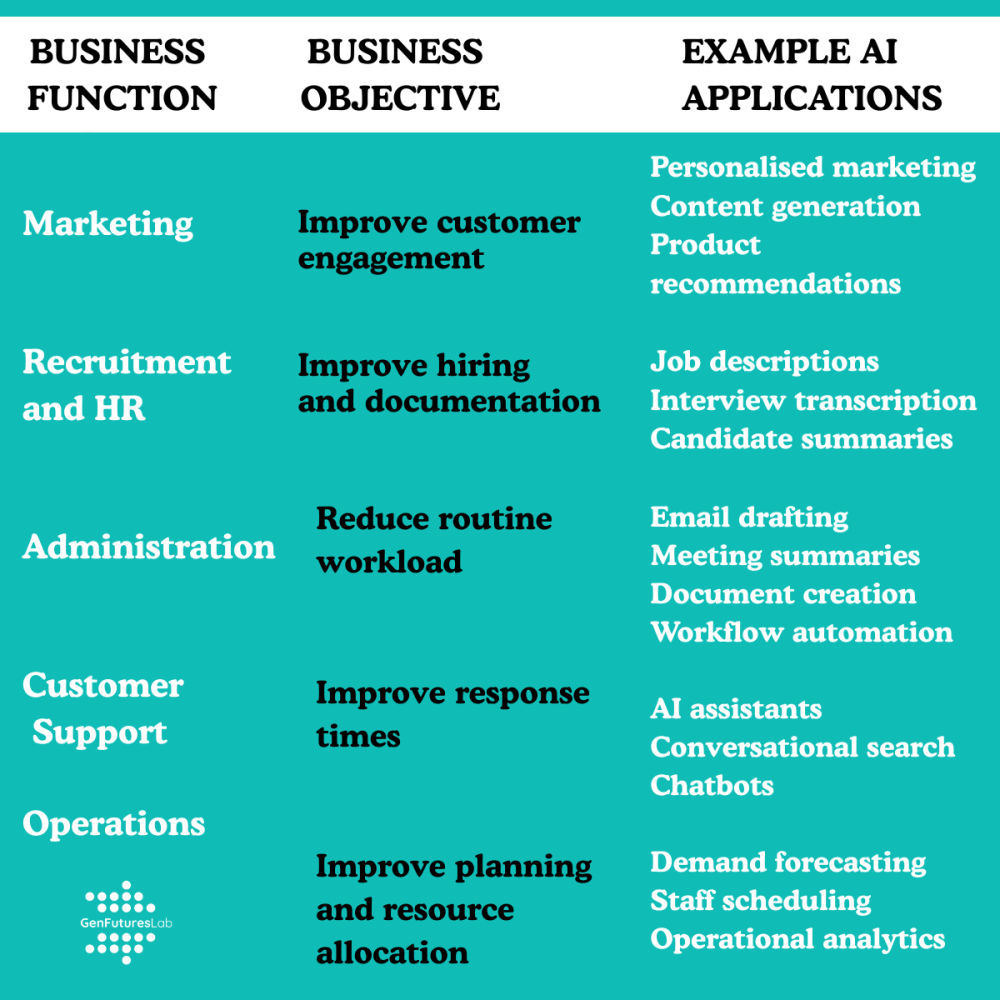
The examples throughout this newsletter demonstrate that successful AI adoption begins with identifying a business need rather than selecting a particular technology. Different AI tools support different objectives, depending on the organisation and the challenges it is trying to address.
Over to you
Although most organisations operate on a much smaller scale than Disney, the same principle still applies. AI is most effective when it is introduced to solve a clearly defined business problem rather than simply because the technology is available.
What business challenge could AI help your organisation solve?
If you found this edition useful, please consider forwarding it to a colleague.