
New Rules Now Force AI Content To Carry A Trail.
It Won't Tell You Who Did The Thinking.
FutureShifts | Second August 2026 Edition
Have you ever copied a paragraph from an AI chatbot into an email or a post and wondered whether anyone could tell?
This Second August 2026 edition of FutureShifts looks at the trail AI now leaves behind: the new EU rules forcing AI content to carry a machine-readable mark, what watermarking actually proves (and doesn’t), and why detection, watermarking, provenance and visible labelling keep getting confused with each other.
We’ve also rounded up the 5 biggest AI developments since our last edition.
Happy reading.
AI in Focus: Recent Developments
•Nvidia is guaranteeing up to $105bn to underwrite OpenAI’s new Ohio data centre.
•The US is pushing allies to pick a side in the AI race, threatening exclusion from its new Pax Silica bloc if they also join China’s rival coalition.
•Nvidia and Meta both released open-weight models this week, a direct answer to fast-improving Chinese rivals.
•Anthropic’s push toward a public listing hinges on hitting $200bn in revenue by 2028.
•Google’s Gemini 3.7 Flash launches built for coding and multi-step AI agents, not just chat.
New rules now force AI content to carry a trail
You copy a paragraph from an AI chatbot into an email, report or LinkedIn post. It looks like ordinary text.
New EU rules now require providers of generative AI systems to make covered outputs detectable as artificially generated or manipulated, in a machine-readable form, subject to some exceptions and a transition period for existing systems. Anthropic, Google and OpenAI are all using some version of the same broad idea: AI content that carries a trace of where it came from.
For anyone who works with AI professionally, that trace raises a more practical question than “is this legal.” It’s “what does it actually prove,” and, as some practitioners are already discovering, whether it proves too much.
Why is this happening now?

Article 50 of the EU AI Act became applicable on 2 August 2026. Among its transparency requirements, providers of generative AI systems must make AI-generated or manipulated audio, image, video and text detectable in a machine-readable form.
There’s a transition period. Systems already on the market before 2 August have until 2 December to comply with the specific marking obligation under Article 50(2), which is why marking has rolled out unevenly, applying to new models immediately while older ones catch up. Around 190 organisations, including Anthropic, Google, Meta, Microsoft and OpenAI, signed the EU’s voluntary Code of Practice ahead of the deadline, giving signatories a recognised pathway for demonstrating compliance.
AI no longer produces only text. It generates photographs, music, voices and video, sometimes at a level where simply looking or listening tells us very little about how the content was made. So the question begins to shift from does this look real to can we establish where it came from.
Four things that keep getting confused: detection vs watermark vs provenance vs labelling
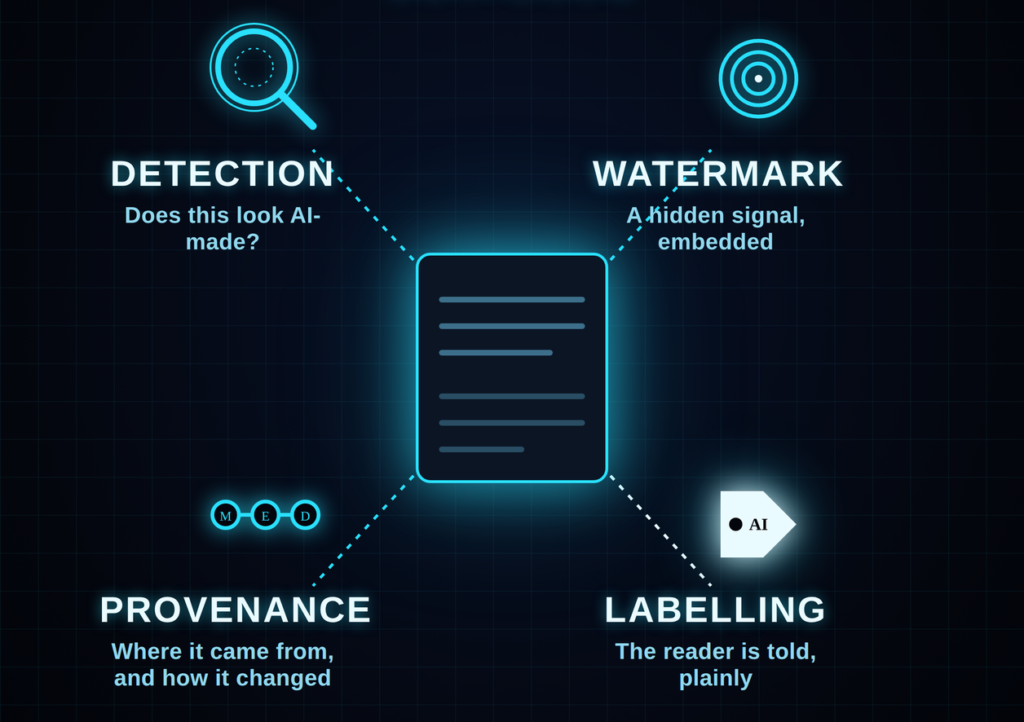
People, understandably, talk about “AI detection” as if it’s one thing. It’s really four, though the EU Act only formally separates one of them out.
An AI detector analyses content and infers whether AI probably generated it, based on statistical patterns in the writing, a third-party technique that sits outside the Act entirely. A watermark is a signal deliberately embedded by the system that produced the content, invisible unless you’re looking for it.
Provenance goes a step further than a watermark. Instead of just a hidden signal, it’s more like a travel history attached to a file: where it was made, what tools touched it, and what changed along the way. C2PA, an industry group, has built a standard version of this called Content Credentials, which they compare to a nutrition label: not a judgement on whether the content is good or trustworthy, just a factual record of where it came from. Legally, it’s worth knowing that watermarking and provenance aren’t treated as separate requirements, they’re just two different ways of satisfying the same EU rule that AI content has to be detectable somehow.
Visible AI labelling is different again: an on-the-record disclosure a human or platform adds, and a separate disclosure obligation under Article 50(4). It applies specifically to deepfakes and certain AI-generated text on matters of public interest, distinct from the machine-readable marking obligation under Article 50(2).
The first three don’t necessarily produce anything visible to an ordinary reader. The fourth is specifically intended as a disclosure. Conflating them is easy and increasingly consequential: a business can be fully compliant on machine-readable marking while having no visible label anywhere, and vice versa.
What the major AI companies are actually doing
The approaches diverge more than the shared vocabulary suggests.
Anthropic embeds an imperceptible watermark directly into text generated by supported Claude models at model level, designed to follow the text through copying and some editing, alongside signed C2PA metadata for supported files. It hasn’t yet published enough technical detail to confirm the mechanism works the same way as Google’s.
Google uses SynthID across Gemini text, and across Imagen, Veo and Lyria for images, video and audio. SynthID works by subtly adjusting the probability scores behind a model’s word choices, so a passage ends up carrying a statistical pattern that can later be analysed for the watermark’s presence, rather than any visible label or hidden string of words.
OpenAI takes a narrower path on text. It uses C2PA Content Credentials and SynthID for supported images, and extended SynthID to supported ChatGPT voice output in July, but hasn’t announced an equivalent watermark for ordinary ChatGPT text, despite researching text watermarking and classifiers.
Microsoft and Adobe, while not building their own watermarking systems, are both C2PA members and emit Content Credentials from Copilot and Firefly respectively, adding provenance metadata without an embedded statistical watermark.
The practical consequence: copying a paragraph from one AI model can mean something completely different, provenance-wise, than copying one from another, and there is currently no universal detector covering all of these approaches.
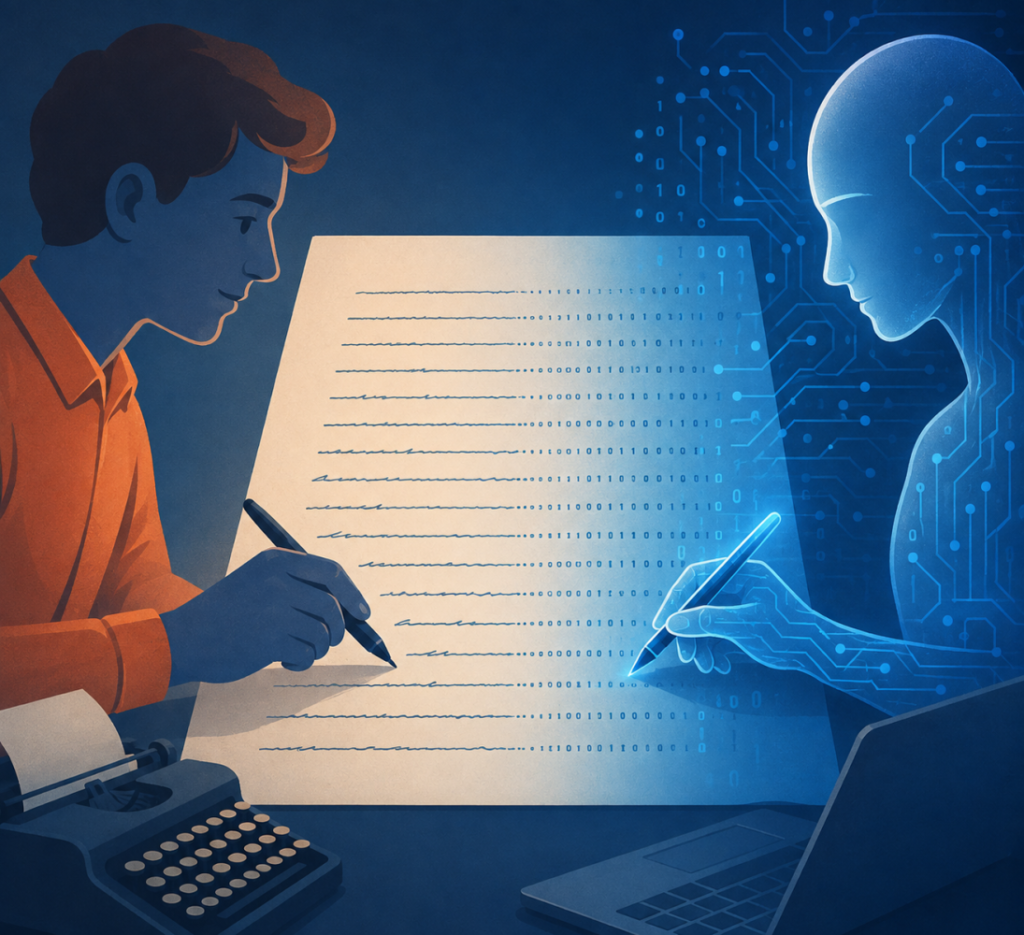
Then comes the difficult question: what counts as AI-generated?
The idea sounds simple when AI creates something from beginning to end. Ask a model to write a 1,000-word article from a short prompt, and there’s a strong case the result is AI-generated. But that’s increasingly not how people use AI at work.
Imagine three people: one asks AI to write an entire report, one writes the report but asks AI to rewrite several paragraphs, and one writes everything independently before using AI for routine editing. All three have used AI. Have all three created the same kind of AI-generated content?
The EU’s rules already recognise some of this. The European Commission says the Article 50(2) marking obligation doesn’t apply where an AI system is performing an assistive function for standard editing. But that still leaves a grey area: what happens when AI substantially rewrites a paragraph rather than correcting it, or turns research notes into polished prose? A report might begin with human research, pass through an AI editor, return to its author, go through another model for fact-checking, then get a final human rewrite. There may no longer be a neat line between human-written and AI-written.
A watermark may tell us AI was involved. It may not tell us who did the thinking.
Anthropic makes this distinction itself: detecting a Claude mark doesn’t necessarily mean Claude was the original author, since someone might use Claude to proofread, translate or transform material that originated elsewhere.
Consider two articles. One author spends days researching and developing an original argument, then asks AI to improve two paragraphs. Another types “write me an article about this.” Both finished pieces could contain AI-generated language, but the human contribution behind them is entirely different. A label as simple as “AI-generated” hides as much as it reveals.
LinkedIn has run into a version of this problem itself. On 30 July, it introduced a “Seems like AI slop” reporting button and retired its own AI rewriting feature in favour of a lighter proofreading tool, after data suggested a large share of long-form posts on the platform were fully AI-written. Tellingly, LinkedIn’s chief product officer drew the same line this piece keeps drawing: AI slop and AI-assisted writing aren’t the same thing, and plenty of people use AI to refine their own thinking rather than replace it.
Provenance is not truth
An AI-generated image can carry perfect provenance information and still depict something that never happened. A human-written article can contain no AI at all and still be wrong. A genuine photograph can be paired with a misleading caption. Provenance tells us something about origin. It cannot tell us whether something deserves to be believed.
C2PA deliberately separates those concepts, aiming to provide information about a piece of content’s history rather than telling people what judgement to make about it. That distinction matters more the more these systems spread, into publishing checks, platform moderation and business records of which tools touched a given document.
Perhaps we are asking the wrong question
For the past few years, debate around generative AI has mostly focused on one question: was this made by AI? New rules make that easier to answer in some circumstances.
But as AI becomes woven into everyday work, a more useful question may be what the human contributed. If AI corrected your grammar, did it write your article? If it suggested your headline, is the piece AI-generated? If it substantially rewrote your argument, has it become something closer to a co-author? LinkedIn, regulators and Anthropic itself all seem to be circling the same answer: involvement and authorship aren’t the same thing. The tools for spotting AI involvement keep improving. The question of who did the thinking stays exactly as hard.
Over to you
At GenFutures Lab, we think carefully about where AI assistance ends and our own judgement begins. If this edition raises questions about how to think about AI involvement in your own work, or how to talk about it with clients or colleagues, get in touch. We’re always happy to talk it through.
If you found this edition useful, please consider forwarding it to a colleague.