
Organising for AI: who owns what
FutureShifts | Third October 2026 Edition
Five Decisions Behind AI Adoption
This edition looks at the ownership decisions behind AI adoption: who is accountable for results, platforms, data, risk and the work that crosses teams. It also covers how to give AI champions the time they need and how to decide what happens to the time AI saves.
We’ve also rounded up 5 of the biggest AI developments since our last edition.
Enjoy the read.
AI In Focus: Recent Developments
- Anthropic files for a Nasdaq listing. Anthropic has filed to list its shares under the ticker ANT. The filing reports revenue of $16.3bn in the first half of 2026, up from about $1.16bn a year earlier. As of 30 September, more than 11,900 customers had generated at least $100,000 in revenue over the previous 12 months. The proposed share price range has not yet been announced.
- Microsoft offers voluntary exits to around 60,000 employees. Microsoft has announced a voluntary exit programme for eligible employees in participating teams in the US, Canada, India and the UK. TechCrunch reports that about 60,000 staff at vice president level and below are eligible, out of around 223,000 employees, and that the move is part of an effort to reduce costs and reshape the workforce as AI investment grows.
- Delaware’s proposed AI-run companies face congressional scrutiny. Delaware is developing legislation that could let companies have their day-to-day operations managed by an AI agent. A designated member would keep the company adequately funded, and the agent would keep a record of its activities. On 26 October, House Oversight Committee chairman James Comer requested information from Delaware’s governor about the proposal’s risks and transparency.
- Privacy group files complaints against Scale AI. The European privacy organisation noyb has filed five GDPR complaints in Austria, France, the Netherlands and Italy about Scale AI’s Outlier platform. It alleges that the platform runs trackers linked to TikTok, LinkedIn and Facebook while freelancers work, and requires repeated identity checks using facial video and ID documents. The allegations have not been established as GDPR violations.
- Apple adds conversational memory to Siri AI, but not in the EU. Apple’s iOS 27.2 update lets Siri’s new AI features recall previous conversations and adds French, Japanese, Korean, Portuguese and Spanish. Users also get more control over which apps Siri can access. The AI features remain in beta and are unavailable in the EU, where Apple has cited the Digital Markets Act.
Organising for AI: who owns what
The decisions behind AI adoption
As AI use expands across an organisation, leaders face decisions that may not have been necessary when only a few teams were experimenting. Who approves the tools and decides which processes to automate? Who is accountable for the data those tools rely on? And who takes responsibility when a process involves several departments?
These decisions can be harder than choosing the technology itself, because they affect how people work together and where accountability sits.
Frameworks such as the hub-and-spoke model and the AI Centre of Excellence give this work a shape, with a central team setting standards and providing shared tools while departments find their own uses. They leave the ownership questions open.
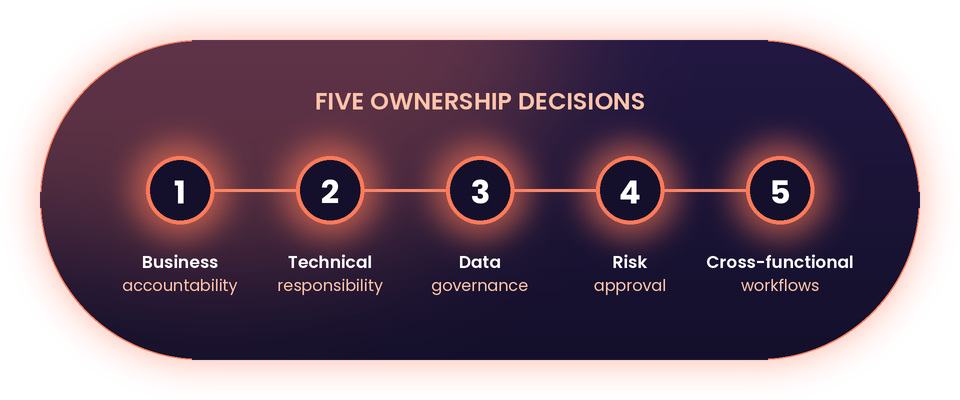
McKinsey’s State of AI 2026 survey suggests why those questions matter. 80% of respondents said AI had improved their individual productivity, but only 37% reported a positive impact on EBIT. Among the small group of high performers, nearly three-quarters reported substantially redesigning workflows, compared with one-quarter of other organisations. This is an association, not proof of cause, but it suggests that how work is organised matters as much as the tools.
Five ownership decisions
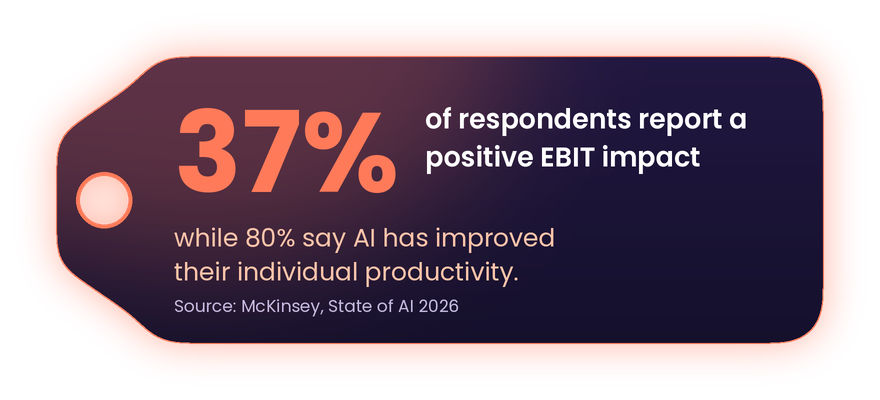
These are our suggestions, and each organisation will settle them differently. Business accountability, technical responsibility, data governance and risk approval are different responsibilities. They may sit with the same team or with different ones, but making each one explicit avoids the assumption that IT should decide everything about AI.
1. Business accountability for results. The head of each department owns what AI does in their area: which tasks are worth changing, whether the output is good enough and what happens to any time saved. Champions do much of the testing, but accountability stays with the business.
2. Technical responsibility for platforms. The technology team, or a central AI team within it, looks after approved tools, integration, security and access. Its role is to make building safe and straightforward for departments, not to set their priorities.
3. Data governance. Different departments may create, maintain and use the same data, so ownership can’t simply follow whoever produces it. A practical approach is to name one business owner for each important dataset, accountable for its quality and day-to-day use. These owners work within organisation-wide security, privacy and access policies, and common standards such as shared definitions and quality checks apply across the organisation. Where the data team sits is a trade-off. A central team makes consistency easier but can be slow to understand what departments need. Specialists placed in departments know the work better, but standards can drift. Gartner describes several possible directions for data leadership, from a specialist role within IT to a leader driving change across the business, so there is no single right model.
4. Risk approval. Approval should reflect the data a tool uses, the consequences if it gets something wrong and how much it does without a person checking. Even a simple use can be sensitive. A tool that summarises meetings may handle confidential or personal information, and one that approves payments or replies to customers acts on its own output. Uses that carry legal, financial or reputational risk need sign-off from people outside the team that built them, such as legal, compliance and information security, together with the relevant business leader.
5. Cross-functional workflows. When a process crosses departments, each team tends to own its own step while nobody owns the handoffs. McKinsey recommends making a cross-functional team accountable for the whole workflow, on the grounds that no single function can redesign handoffs it only partly controls. We would add that this team needs a senior sponsor with the authority to settle disagreements between departments.
Some companies have also changed their reporting lines. Moderna combined its HR and IT teams into one People and Digital Technology department under Tracey Franklin, previously its chief HR officer. Franklin has described it as a work in progress that won’t suit every organisation.
Who turns needs into working solutions
Someone has to turn a department’s needs into a working solution. LinkedIn offers one example of how these roles are evolving. It has replaced its Associate Product Manager programme with an Associate Product Builder programme that combines coding, design and product management. It has also introduced a Full Stack Builder career path, intended to give people from different functions the skills to take products from idea to launch. Its chief product officer, Tomer Cohen, has said culture matters more to making it work than the tools. Where an organisation has product managers, they are well placed to do this translation alongside departmental champions. Where it doesn’t, the job may fall informally to a capable champion, who then needs time and a clear remit to do it.
A hypothetical example: from supplier approval to payment
Imagine a company that wants to use AI in the process from approving a new supplier to paying its first invoice. Procurement approves suppliers. Finance owns payment rules and controls. IT manages integration and security. The data team keeps supplier records accurate. Each could improve its own step and still leave invoices waiting between steps.
Under one process owner, the teams would agree what AI handles and where people step in. AI could check new supplier details and match each invoice to its purchase order and delivery record. Once that matching had been tested and approved by finance, the company could consider letting invoices that match within agreed limits go through without manual handling. Mismatches and unusually large amounts would go to a named person. In this scenario, we would recommend that any change to a supplier’s bank details is verified independently by a person, for example by calling the supplier on a number already on file, because requests to change bank details are a recognised route for payment fraud. Action Fraud advises verifying such requests using contact details you already hold. Every automated decision would be logged so finance and auditors can trace it, and finance would keep authority over payment controls.
Success would be measured across the whole process: the time from supplier approval to payment, the share of invoices handled without manual work, the number of exceptions and how quickly they are resolved, payment errors and staff time freed.
There is no fixed order for this kind of work. One option is to put shared tools and rules in place first, let each function improve its own work and move to cross-functional processes once owners and data are ready. Where most of the delay sits between departments, starting with one well-defined cross-functional process may bring results sooner.
Deciding how saved time is used
McKinsey’s October article argues that leaders need to choose explicitly where capacity released by AI goes, whether to more output, different work or more sustainable workloads. For a departmental leader, the practical difficulty is that savings can be scattered: ten minutes on a report here, a few minutes on an email there. Small amounts like these don’t easily add up to time anyone can plan with.
A manager could start by asking the team where AI has saved noticeable time over a month and grouping the savings by task. Where a saving is large and regular, for example in a hypothetical case where a weekly report that used to take a day now takes an hour, it can be allocated deliberately to more output, better quality, training or a lighter workload. Some of it could fund the champion role described below, so that the people helping others adopt AI aren’t doing it in their evenings.
Making time for champions
A hub-and-spoke model depends on champions in each department, and the role is often added on top of a full job. Workera surveyed 1,000 employees at US organisations with 5,000 or more staff. The share of companies offering AI training had risen from 25% to 58% in a year, yet 56% of employees named a lack of time during work hours as a barrier to building AI skills.
We recommend treating the champion’s time as part of the job. In practice, that means writing a set number of hours into their objectives, agreeing with their manager which work moves elsewhere to make room and reviewing the arrangement each quarter.
The second part of the role is sharing what champions learn without adding to the messages people already receive. Gallagher’s 2026 Employee Communications Report found that 83% of the communications and HR professionals it surveyed see information overload as a growing problem. Options include a short slot in existing team meetings, a monthly session where champions from different departments compare what they have tried and a shared, searchable record of what worked and what didn’t.
The takeaway
Three questions are worth putting to your leadership team:
- For each AI use in your organisation, can you name who is accountable for the result, who maintains the technology, who owns the data and who approved the risk?
- Which process that crosses departments would benefit most from a single owner, and who would that be?
- How much time do your AI champions have for the role this month, and who decides how the time AI saves is used?
Over to you
If your organisation is exploring how AI could improve productivity, decision-making or customer experience, we’d be happy to discuss where it can create the most value. Our AI Adoption Diagnostic is a practical place to start. Get in touch.
If you found this edition useful, please consider forwarding it to a colleague.