
SPEAK TO YOUR DATA! The Rise Of Conversational Analytics
FutureShifts | Second September 2026 Edition
Have you ever asked someone for a quick number and waited three days for the answer?
This edition looks at conversational analytics: the fast-growing shift that lets anyone ask their company’s own data a question in plain English and get a straight answer back, no analyst and no code required. We look at why Snowflake, Databricks and Microsoft have all bet on this in the past year, what has to be built underneath it to make it trustworthy, and where the caution still belongs.
We’ve also rounded up the 5 biggest AI developments since our last edition.
Happy reading.
- OpenAI opens its Agents API to developers. OpenAI has moved its Agents API into public beta, giving businesses a managed way to build AI agents that can run code, edit files and connect to outside tools, though it is currently limited to US data residency.
- Anthropic publishes a threat intelligence report on AI-enabled attacks. The report details state-linked and criminal misuse of Claude since December 2025, including cyber operations and a large-scale attempt to distil its outputs into a rival model.
- Nvidia backs a 2-gigawatt AI build-out in Australia. Nvidia is working with eight Australian data centre and infrastructure partners to support up to 2 gigawatts of AI computing capacity by 2027, with Atlassian and healthcare platform Heidi named among the organisations using its AI technology.
- Anthropic’s chief executive sets out a plan to slow frontier AI. Dario Amodei has proposed three steps for the industry, including outside oversight of frontier labs and common safety limits agreed between leading developers in democratic countries.
- Google brings the Gemini app to Windows. Google has launched a dedicated Gemini desktop app for Windows, drawing on Gmail and Google Drive and opened with an Alt+Space shortcut.
Business data is starting to answer questions in plain English
For most of the last two decades, getting an answer out of a company’s data meant asking someone else to get it for you. You had a question. A data analyst had the tool. In between sat a support ticket, a message, or a dashboard that almost, but not quite, answered what you actually wanted to know.
That’s the gap conversational analytics is built to close: type or speak a question in ordinary language, such as “which regions grew fastest last quarter” or “why did returns spike in March”, and get a direct answer, drawn from the organisation’s own data, without writing a line of code.
The idea itself isn’t new. Natural language query tools have existed for years, often bolted onto business intelligence dashboards, translating words into queries through fairly rigid rules and frequently getting it wrong. What’s changed is who is now backing this generation of the idea, how it’s built underneath, and how many organisations are already using it day to day rather than trialling it.
Why this is suddenly everywhere
Three moves in the past year show how quickly this has shifted from experiment to everyday tool.
Snowflake Intelligence, which lets users ask natural language questions against their own Snowflake data, went fully available to Snowflake’s customer base of more than 12,000 organisations on 4 November 2025. At that point, over 1,000 customers had already put more than 15,000 of these tools to work. Wolfspeed, the semiconductor maker, said equipment troubleshooting that used to take two hours now takes two minutes; Toyota Motor Europe and Cisco reported similar early results. By April 2026, Snowflake said more than 9,100 customers were using its AI tools every week.
Databricks made a similar bet on 16 June 2026 with the launch of Genie One, which it describes as a coworker that lets business teams ask questions about performance, generate documents and set up alerts, all grounded in the company’s own data and business context.
Microsoft, meanwhile, confirmed it will retire Power BI Q&A, its older and more rigid natural language search tool, in December 2026, pointing customers instead towards Copilot. Retiring a decade-old feature in favour of a newer AI-based replacement is as clear a signal as any that the first generation of these tools has been quietly overtaken.
What ties these announcements together isn’t the chat box itself, that part looks similar everywhere, but the fact that all three vendors are now connecting it to the company’s own real, permission-controlled data rather than a general purpose AI model guessing at an answer. That distinction is the reason this wave of tools is being taken seriously by data teams who were sceptical of the last one.
The part doing the real work
None of this works if the AI is left to guess what a word like “revenue” or “active customer” actually means inside a specific business. That job belongs to what’s usually called a semantic layer: an agreed, documented map that sits between the raw data and the chat box, so the AI calculates the right thing before it ever answers.
Databricks’ own documentation is candid that this is the piece earlier AI tools got wrong: information scattered across different systems, with much of what actually matters about a business living only in employees’ heads rather than somewhere an AI can look it up. Building that shared map, agreeing what each number means and where the correct version of it lives, is most of the real work in setting up conversational analytics properly. It isn’t something a vendor can sell as a one-click feature. It has to be built around the specific business asking the questions.
Think of it less like installing software and more like writing down, once and properly, the answers to questions that usually only live in one person’s head: does “active customer” mean logged in this month or bought something this month, does “revenue” include tax, does a return count against the month it was sold or the month it came back. Every business already has answers to these questions, they’re just usually inconsistent and different depending on who you ask. Doing this work properly forces that inconsistency into the open before it gets automated at scale.
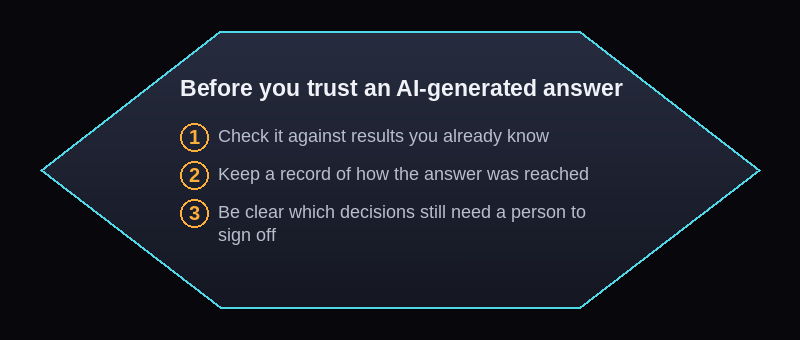
Gartner predicts that 75 per cent of new analytics content will be generated with the help of AI by 2027, up from a small fraction today, and its research already finds that more than half of analytics leaders are using AI tools for natural language questions. But the same research flags a specific risk it calls “agent drift”, where an AI system’s answers gradually drift away from what was actually intended, without anyone noticing until the numbers are already wrong. Gartner’s recommended fix is a separate “guardian” layer whose job is to check the main system is staying within the rules it was set.
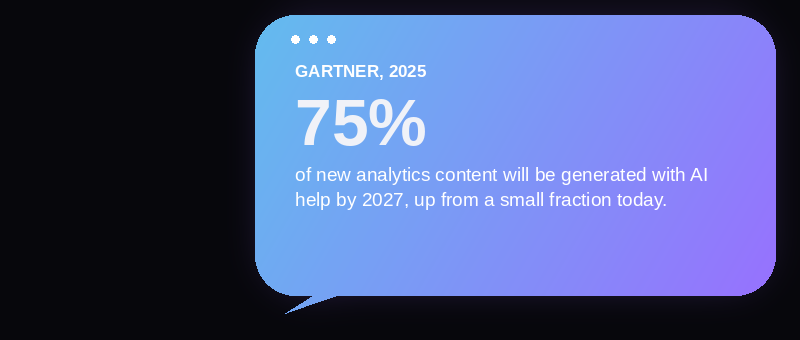
That caution shows up in how finance leaders are actually behaving. A Kyriba survey of 1,000 CFOs, treasurers and senior finance decision-makers across the US, UK, France and Japan found 96 per cent prioritising AI, while 76 per cent still cite security and privacy risk as a concern. Kyriba describes this as a trust gap between AI’s promise and continuing wariness about how it’s governed. That’s a sensible habit to carry into conversational analytics too: check AI-generated answers against known results before relying on them, keep a record of how an answer was reached so it can be checked, and be clear about which decisions still need a person to sign off.
None of that is a reason to avoid conversational analytics. It’s a reason to build it properly. A chat box sitting on top of a badly defined data layer will answer questions fluently and wrongly, which is worse than not answering at all, because a wrong answer delivered confidently is far more likely to be acted on than a shrug.

What it looks like in practice
Strip away the vendor names and the pattern underneath is fairly consistent across industries. A regional manager asks which locations are trending below target this month, instead of waiting for the monthly report to land. A finance team asks why a specific cost line moved, rather than opening three spreadsheets to trace it themselves. An operator running several sites, in senior living, hospitality or retail, asks how this week’s occupancy or usage compares with the same week last year, and gets an answer alongside the figures behind it rather than a chart that needs its own explanation.
None of these are dramatic examples. That’s rather the point. The value isn’t one headline-grabbing use case, it’s the build-up of many small questions that would previously never have been asked at all, because asking them properly meant filing a request and waiting.
What this means for your business
Most organisations reading this won’t be running Snowflake or Databricks at Wolfspeed’s scale, but the underlying shift applies well below that level. Any business that already keeps its numbers in a reasonably organised system, a CRM, a finance tool, a booking platform, can in principle put a conversational layer on top of it. The real return isn’t about saving time, useful as that is. It’s about how many more people in an organisation start asking questions of their own data at all, once the barrier drops from “submit a request and wait” to “just ask”.
The harder part comes before switching anything on: agreeing what the organisation’s key numbers actually mean, where they live and who is responsible for making sure they’re right. That’s less a technology project than a business one, and it usually decides whether conversational analytics earns trust across a team or quietly loses it, one confidently wrong answer at a time.
This is also the kind of groundwork that comes up often in client conversations at the moment, comparing what different platforms actually offer against what a specific business needs, rather than what a vendor’s demo shows
The takeaway
Conversational analytics is no longer an experiment sitting in a vendor’s demo, it’s shipping inside the platforms most businesses already use. The technology is the easy part. The work worth doing first is agreeing, in plain language, what your own numbers actually mean.
Over to you
If this is something you’re weighing up for your own organisation, or you’ve already tried it and hit the data-definition problem described above, get in touch, we’d like to hear where you’ve got to.
If you found this edition useful, please consider forwarding it to a colleague.