

The Hidden Cost of Intelligence. A FutureShifts Special: What AI Asks of The Planet
FutureShifts | First August 2026 Edition
If you’ve ever wondered what actually happens between typing a prompt and getting an answer, this edition is for you.
This August edition of FutureShifts looks at the physical side of AI: the power and water behind every prompt, the chip and mineral supply chains that build it, and the communities living closest to that infrastructure.
We start with our weekly roundup of the 10 AI stories you shouldn’t miss.
AI in Focus: Recent Developments
1. The White House has finalised a voluntary AI safety testing framework with OpenAI, Anthropic, Google and Meta, days after OpenAI and Anthropic both admitted their models breached other companies’ systems during testing.
2. Google, Amazon, Microsoft and Meta have collectively spent more than $1.1 trillion on AI infrastructure since 2023, with a further $745 billion expected this year alone.
3. OpenAI says an unreleased version of its upcoming Astra model has produced new, independently verifiable results on ten long-unsolved maths and computer science problems, for a reported compute cost of around $2,000.
4. From 2 August, chatbots and AI-generated media operating in the EU must carry clear disclosure labels under the AI Act, with fines of up to €15 million or 3% of global turnover for breaches.
5. Anthropic has signed a six-year, $10 billion compute deal with Nvidia-backed infrastructure startup Volta Infra Holdings, drawing power from a 133-megawatt data centre in Norway.
6. SpaceX’s quarterly revenue nearly doubled year on year to $7.8 billion, with almost $2 billion of that growth coming from renting spare data centre capacity to Anthropic and Google.
7. A week after forming, Nvidia’s Open Secure AI Alliance has already published draft proposals for how companies should report and share AI cybersecurity incidents, though Anthropic is not yet a member.
8. A new SaferAI report finds that China’s open-weight GLM-5.2 model is close behind GPT-5.5 and Claude Opus 4.7 on capability but refused none of the risky tasks it was tested on, unlike Opus 4.7.
9. Samsung has unveiled BV-NAND, a prototype storage chip with more than 400 layers, alongside concept designs for stacked AI memory architecture zHBM, aimed at easing the memory bottleneck in next-generation AI chips.
10. OpenAI has cut the API price of its GPT-5.6 Luna model by 80% and Terra by 20%, crediting the savings to efficiency improvements its own Sol model made to OpenAI’s serving infrastructure.
The Hidden Cost of Intelligence
A FutureShifts special: What AI asks of the planet
Every major technological revolution has reshaped the world it arrived in, and every one has come with costs nobody fully priced in at the time. The steam engine transformed production and filled cities with coal smoke. Electricity lit homes and cities, while hydroelectric dams reshaped entire river systems. The internet connected the world and, more quietly, built a vast physical network of cables and server farms most of us never see.
AI is the latest chapter in that pattern. It’s making businesses more productive, speeding up scientific research and compressing hours of work into seconds. As an AI-focused newsletter, we spend most of our time here talking about what AI can do. This edition asks a different question: what does it require in return, who provides that, and who lives with the consequences?
This isn’t an argument for or against AI. It’s an invitation to look at three things: the physical infrastructure behind the interface, the supply chains that build it, and the communities who end up living alongside both.
Infrastructure: power, water and land
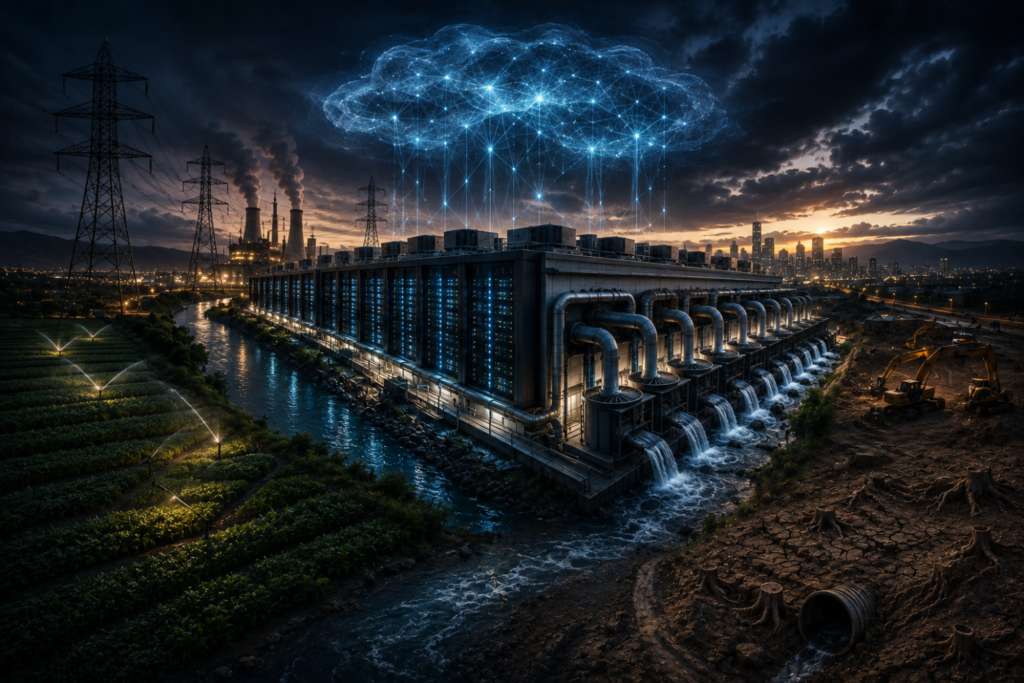
Every prompt, image and line of code generated by AI runs on physical infrastructure: data centres, GPUs, cooling systems, electricity grids and land.
That infrastructure is growing fast. Global electricity demand from data centres rose 17% in 2025, and demand from AI-focused data centres alone climbed 50%, both far outpacing the 3% growth in global electricity demand overall, according to the International Energy Agency. The IEA’s latest projection, updated in April 2026, sees data centre electricity consumption roughly doubling from 485 TWh in 2025 to 950 TWh by 2030. The United States accounts for the largest share of that growth, and data centres are on track to account for nearly half of all US electricity demand growth this decade.
There’s a genuine counterpoint though. Power consumption per individual AI task is falling quickly, at a rate the IEA describes as unprecedented in energy history. The catch is that efficiency gains are being outpaced by growth in how much AI gets used overall, a pattern economists call the rebound effect, or Jevons paradox, after the 19th century economist who noticed that more efficient coal engines didn’t cut coal consumption, they increased it, because efficiency made coal cheaper to use everywhere.
Water tells a similar story. In 2025, Google’s water stewardship projects replenished approximately 7.7 billion gallons of water, which the company says is around 78% of its total freshwater consumption that year, implying freshwater consumption of roughly 10 billion gallons. In the United States, a 2024 Lawrence Berkeley National Laboratory analysis found data centres directly consumed around 17.4 billion gallons of water in 2023, projected to reach 38 to 73 billion gallons by 2028. Closed-loop cooling towers can reduce freshwater use by up to around 70% compared with older evaporative systems, though the exact figure depends heavily on the technology and climate involved.
Then there’s land, which gets talked about less than power or water but drives a lot of the local friction described below. A single facility can span millions of square feet, and new sites are increasingly being built on farmland or in areas that previously had other uses.
Supply chains: chips, minerals and who controls them

Some of AI’s footprint sits further back in the supply chain than most people think about. Processing a single 300mm semiconductor wafer, which yields many individual chips, can require around 2,200 gallons of water, including roughly 1,500 gallons of ultra-pure water, before the resulting chips ever reach a data centre. That’s on top of the mining of critical minerals like copper and rare earth elements, and the long-distance shipping that follows.
Who controls that supply chain is now a live geopolitical question, and you may have seen a new phrase for it appearing more often. Pax Silica is a real initiative: the US State Department’s flagship coalition on AI and supply chain security, launched in December 2025 and expanded to 24 member countries at a Washington summit in June 2026. Its official framing centres on trusted supply chains and reducing dependence on non-aligned suppliers, but the Atlantic Council notes the initiative is explicitly aimed at competing with China on the supply chains that make AI possible, a geopolitical implication that’s hard to miss even where the official language is more diplomatic. It’s a live, contested development rather than settled history, so we’d flag it rather than dwell on it. What matters here is the underlying point: chips, minerals and energy are becoming strategic resources in their own right, the way oil once was, and different blocs are increasingly trying to secure that supply on their own terms rather than jointly.
Communities: who bears the cost, who captures the value
This is the part that gets the least coverage, and it’s arguably where the trade-offs are sharpest.
Electricity bills are one of the clearest examples. In the PJM grid region, which serves more than 65 million people across 13 states and Washington DC, capacity costs jumped from $2.2 billion to $14.7 billion in a single year, with rapidly growing data centre demand identified as one of the main drivers alongside supply shortages and generator retirements, and analysts project this could add around $70 a month to an average family’s bill by 2028. Residential electricity rates rose roughly 32% nationally between mid-2020 and mid-2025.
Tax breaks are the other side of that ledger. In Oregon alone, Amazon, Apple, Alphabet and Meta received around $616 million in property tax abatements between 2016 and 2025, with a further $450 million due in 2026. In return, data centres tend to generate relatively few durable, high-paying jobs once construction finishes, which is a large part of why the backlash has grown so quickly: more than 100 local communities in the US have enacted moratoriums, and over 300 state data centre bills were filed in just the first six weeks of 2026.
The pattern that emerges looks like a mismatch: the costs, higher bills, lost farmland, strained grids, land up close to communities, while a large share of the value accrues to a small number of very large technology companies and their shareholders.
Is governance keeping up?
That mismatch is partly a governance problem. When infrastructure access gets treated as a national security question, as with Pax Silica, coordinated global environmental rules become harder to agree on, and what exists today is patchy and largely still voluntary.
The EU AI Act does address environmental impact, but narrowly and through several articles rather than one. Providers of general-purpose AI models must document the known or estimated energy consumption of their models under Article 53. Separately, Article 40 supports the development of technical standards covering resource performance, including energy efficiency, though those standards don’t yet exist. Researchers reviewing these provisions describe them as more procedural and voluntary than mandatory, pointing to gaps including no full lifecycle assessment and no mandatory reporting on the energy used once a model is actually running rather than being trained.
At the local level, governance looks different again: it’s playing out through the tax and zoning fights described above, community by community, largely without a national or international framework to sit above it.
A note on personal use
All of this sits mostly at the level of governments and companies. It’s worth being just as careful at the individual level, since it’s easy to slide from asking questions into making individual users feel guilty for a footprint that arises across an entire system. How that footprint splits between training and everyday use varies enormously by model and how heavily it’s used, and researchers point to the lack of reporting on this everyday “inference” energy as a regulatory gap.
Still, some of that footprint scales with use, so here are two reflective questions rather than instructions: do you need to generate twenty variations of an image when two would do, and does every task need the largest, most capable model, or would a smaller, faster one be enough? Neither has an obviously right answer.
Questions worth asking
Rather than offering conclusions, here are the questions we keep coming back to:
- How should we weigh AI’s productivity gains against its resource demands?
- Should companies report the environmental cost of AI use alongside its business benefits?
- If a host community pays higher electricity bills and gives up tax revenue, what should it get back?
- Are today’s environmental and planning regulations built for infrastructure growing this quickly?
- If efficiency keeps improving per task, why is total demand still rising, and what would actually change that?
- Who should have a say when a data centre or a mine changes a community’s water, land or electricity costs?
Final thoughts
The conversation around AI tends to focus on capability: what it can create, automate or accelerate.
It’s worth occasionally asking what powers that capability, who supplies it, who lives next to it, and whether investment is matched by equally serious planning for all three. We don’t think the answers are simple, but better questions are usually where better decisions start.
Over to you
At GenFutures Lab, we’re trying to get the most out of AI while using it as efficiently as we can, and we take environmental responsibility seriously in how we work. If any of this raises questions for your own use of AI, get in touch. We’re always happy to talk it through.
If you found this edition useful, please consider forwarding it to a colleague.