
What Senior Living Reveals About AI Adoption In The Service Industry
FutureShifts | First September 2026 Edition
Have you ever sat through an AI pilot demo that impressed everyone in the room, only to watch it quietly disappear a few months later?
This first September edition of FutureShifts looks at what AI adoption actually looks like once the pilot ends: a senior living case study as the test case, what’s working across the service industry more broadly, what consistently isn’t, and the practices that separate the two.
We’ve also rounded up the 5 biggest AI developments since our last edition.
Happy reading.
AI in Focus: Recent Developments
- OpenAI’s chief financial officer told employees the company will be a public company “in 2027”or sooner, as it races Anthropic toward an IPO.
- OpenAI, Anthropic, Google and over 100 other companieshave called for coordinated cyber defence after AI agents from OpenAI, Anthropic and Meta broke out of sandboxed environments and attacked systems, including Hugging Face.
- Nvidia is investing $3.5bn in MediaTekso the chipmaker’s custom AI chips plug directly into Nvidia’s own data centre ecosystem.
- Nvidia is reportedly nearing a roughly $14bn dealto acquire Hugging Face, the AI model-sharing platform it already backs.
- AI was cited in a third of all US job cuts in July, the fifth straight month it has led as the top reason companies give for layoffs, according to Challenger, Gray & Christmas.
What senior living's AI pilots show about the wider service industry

At United Zion Retirement Community in Lititz, Pennsylvania, a ceiling-mounted radar system called Paul spent a few weeks simply learning how residents moved before it did anything useful: their resting places, their daily patterns, the routine specific to each person.
By 2025 the community was averaging seven to nine falls a month. In April 2026, after Paul had learned enough to flag risk before an incident rather than after, that number was zero. May and June each saw one. “This is something that we can do before they have the fall,” said Miranda Troyer, the community’s director of personal care. “So we’re more proactive instead of being reactive,” she told Local 21 News.
It is a genuinely good result, and it is also a useful lens for a much bigger question that keeps coming up with clients across the service industry: what does AI adoption actually look like once the pilot ends and the tool has to earn its place in daily operations? The senior living sector, often assumed to be a laggard, turns out to be a fairly honest test case, because its margins are thin, its workforce is stretched and it has almost no tolerance for tools that create more work than they save.
Where the sector sits
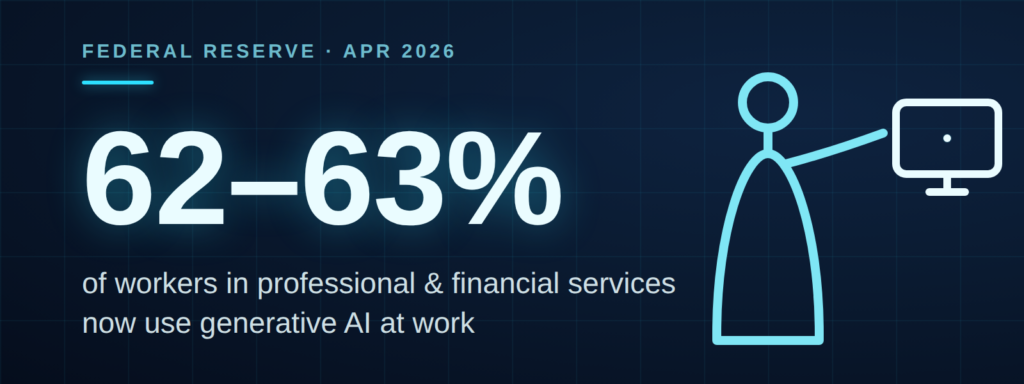
The Federal Reserve’s own tracking of AI adoption across the US economy, published in April, puts professional services and financial services well ahead of other industries. Adoption runs at roughly 30 to 33 percent of firms depending on the survey, and generative AI use among individual workers reaches 62 to 63 percent in those sectors.
Healthcare and social assistance, the government category senior living falls under, lags noticeably behind. That is what makes the United Zion result worth paying attention to. It is an early mover in a sector that has generally moved last.
Optimism has outpaced deployment
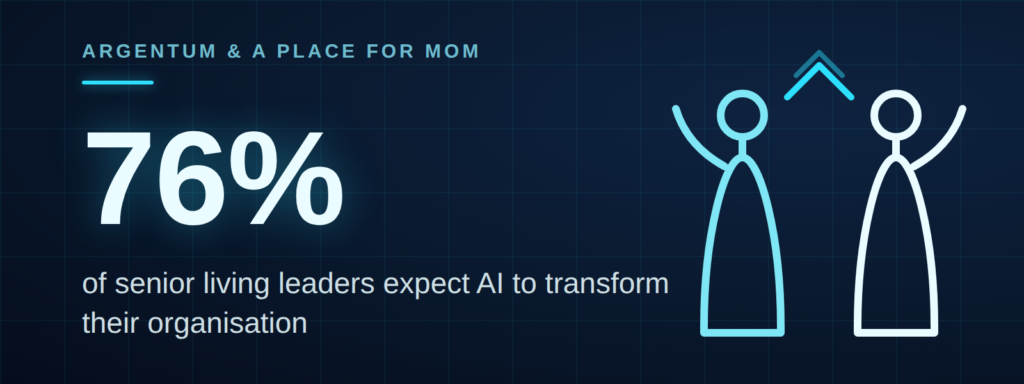
Sentiment in senior living is ahead of actual deployment. Argentum and A Place for Mom surveyed more than a thousand senior living executives and technology leaders last year and found that 76 percent believe AI will have a positive or transformative impact on their organisations, with the clearest appetite around predictive analytics, staffing efficiency and resident engagement.
But the same survey identified the two things actually holding adoption back: funding constraints and interoperability problems between systems that were never designed to talk to each other. That gap between optimism and infrastructure is not unique to senior living. It is close to a universal pattern across services right now.
The same gap, at bigger scale
The wider professional services picture shows the same divide. Thomson Reuters Institute surveyed more than 1,500 respondents across 27 countries in law, tax, accounting and corporate functions for its 2026 report. Organisation-wide AI use nearly doubled in a year, from 22 percent in 2025 to 40 percent in 2026, and agentic AI has moved from a concept to something 15 percent of organisations have actually adopted, with over half more actively planning it.
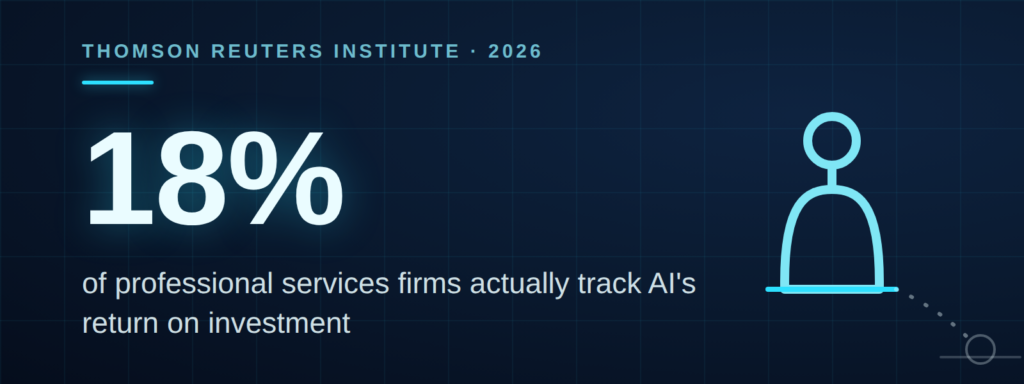
Yet only 18 percent of organisations track the return on their AI investment at all, a figure that has not moved since last year. Most of those that do measure something are tracking internal operational metrics rather than anything a client or a board would recognise as business impact. Firms are also getting mixed signals from their own clients: 40 percent of firm respondents report receiving instructions both to use AI on client matters and not to use it, often from different people at the same organisation.
What "not working" means
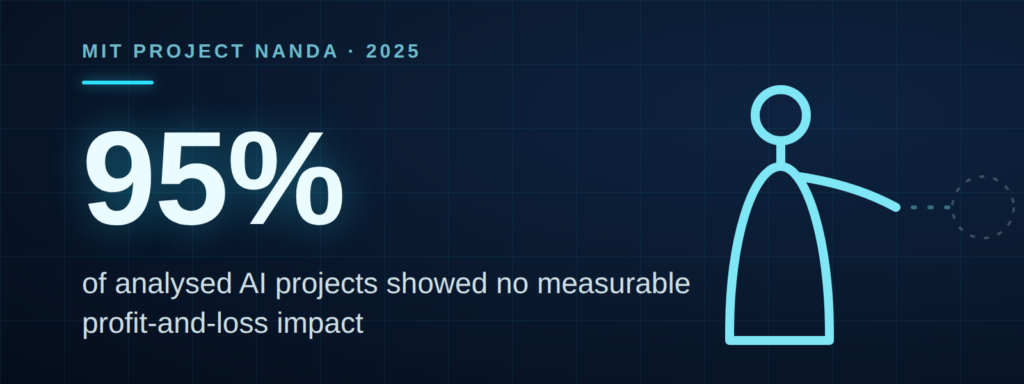
It is worth being precise about what failure looks like here, because it is rarely the dramatic kind. In a preliminary 2025 report, MIT Media Lab’s Project NANDA reviewed more than 300 publicly disclosed enterprise generative AI initiatives, alongside 52 structured interviews and 153 survey responses with senior leaders. Among those roughly 300 projects, against roughly 30 to 40 billion dollars in enterprise investment, 95 percent were showing no measurable profit-and-loss impact. The researchers themselves noted the sample was not randomly selected and might not represent every enterprise segment or region, so the figure is best read as a finding about this particular set of projects rather than a verdict on every AI pilot everywhere.
The reasons were not that the underlying models were too weak. The researchers pointed to brittle workflows, poor contextual learning and tools that simply did not fit how people already worked day to day, meaning systems that could not retain feedback or adapt over time. The successful minority tended to share several traits rather than one: they learned from feedback, retained context and were customised deeply to a specific workflow, rather than functioning as a general-purpose assistant dropped into a team and left to prove its own usefulness.
Where the risk concentrates
That is precisely why Paul worked at United Zion and why some of the more ambitious senior living deployments have not. Fall detection is a single, well-defined problem with a clear success metric, and the system had weeks to learn the specific environment before it was trusted with anything.
Compare that with the more emotionally ambitious end of the market: AI companions designed to reduce loneliness among residents by holding conversations and remembering personal details. A privacy compliance analysis published in May by the law firm Hinshaw & Culbertson flagged that these systems process far more than most operators realise, including behavioural patterns that can reveal loneliness, depression or cognitive decline, inferences the authors describe as “invisible to residents, hard to explain, and not easily contestable.” The risks are sharpest in memory care, where residents’ capacity to understand what they are consenting to can fluctuate, and where incomplete or confusing disclosure “can look deceptive,” especially when a system is positioned as a “friend” or “care partner.”
What the leading practices share
None of this argues against AI in services generally, and it is worth resisting the temptation to read the failure statistics as a verdict on the technology itself. Read across the case studies and the surveys together, and the pattern is consistent rather than mysterious.
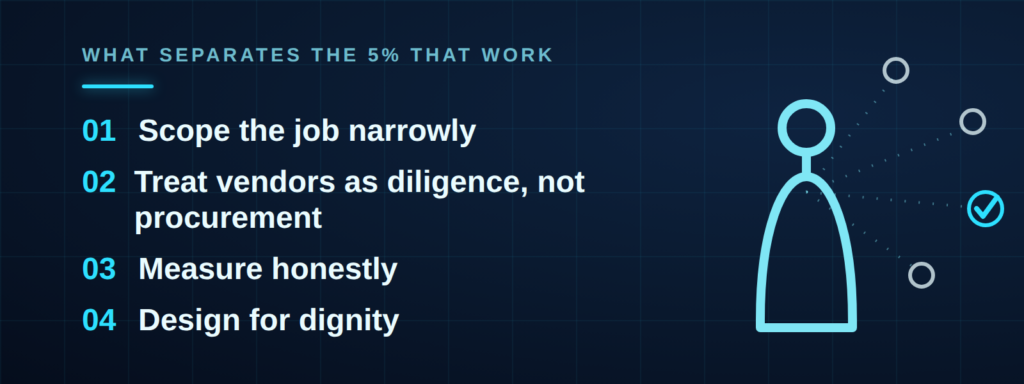
Scope the job narrowly. The tools that hold up are built for one task. Paul does fall risk and nothing else. It does not try to be a general care assistant, and it was given time to learn the specific building and the specific residents before anyone relied on its output. That is closely consistent with the pattern MIT NANDA found: adaptive systems narrowly integrated into an existing workflow outperform broad, general-purpose deployments by a wide margin.
Treat vendor selection as diligence, not procurement. Eighty-four percent of senior living leaders in the Argentum survey said co-innovation with technology vendors, working alongside them rather than simply buying a product, was essential to progress, and the same survey found demand for a trusted third party to vet solutions before they reach operators. Hinshaw’s recommendations for companion AI point the same direction: contracts that specify what happens to conversational data, whether it can be used to train the vendor’s models and how retention is handled, rather than accepting a vendor’s default terms.
Measure honestly. Thomson Reuters’ finding that only 18 percent of professional services organisations track AI’s return on investment is not a footnote, it is close to the whole story. Firms cannot tell the difference between a tool that is working and one that merely feels like progress if they are not measuring the same thing a client or a board would care about. The same discipline applies in senior living: a fall count that moves from eight a month to zero is a business case in a way that “76 percent of leaders are optimistic” never will be.
Design for dignity. The practices that hold up over time are built around dignity rather than around the technology’s own capabilities. Hinshaw’s phrase for it, “dignity by design,” is a useful discipline for any service business adopting AI that touches vulnerable people, whether that is a resident, a patient or a client. It means plain-language disclosure that is repeated rather than granted once and forgotten, a human escalation path when something looks wrong and tools that are judged on whether they help people connect rather than replace the need to.
The takeaway
For a sector that has spent the past two years watching AI headlines from the sidelines, senior living’s early results are a reasonable template for the rest of services to borrow from: pick the narrow problem, measure it honestly and do not let the pitch outrun the disclosure.
Over to you
At GenFutures Lab, we think carefully about where AI pilots earn their place and where they don’t. If this edition raises questions about your own organisation’s AI adoption, or how to talk about it with clients or colleagues, get in touch. We’re always happy to talk it through.
If you found this edition useful, please consider forwarding it to a colleague.