
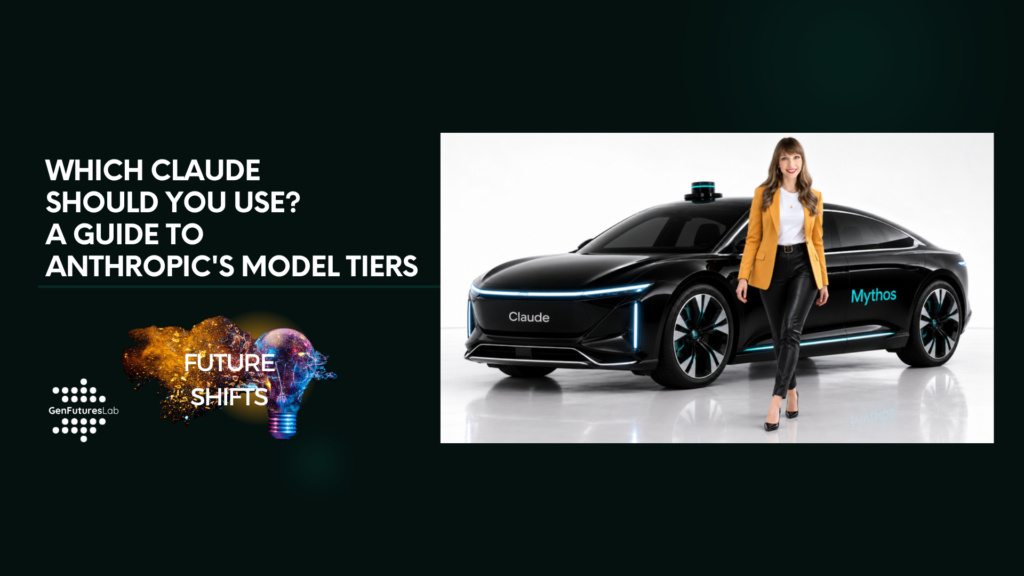
Which Claude Should You Use? A Guide To Anthropic's Model Tiers
FutureShifts | Second July 2026 Edition
Choosing the most powerful AI model isn’t always the right decision. In many cases, you’re simply paying more for capability you don’t need.
This week’s FutureShifts breaks down Anthropic’s Claude model lineup, explaining when to use Haiku, Sonnet, Opus or Fable, what each one costs, and why one company trusted Fable to migrate a 50-million-line codebase in a single day.
We start with our weekly roundup of the 10 AI stories you shouldn’t miss.
AI in Focus: Recent Developments
1. Apple sues OpenAI over alleged theft of trade secrets
Apple filed a lawsuit against OpenAI and two former employees, alleging misappropriation of trade secrets to benefit OpenAI’s move into consumer hardware. OpenAI’s hardware venture io Products was also named. OpenAI said it has “no interest in other companies’ trade secrets”. Source
2. OpenAI gets US approval for a broad GPT-5.6 rollout
Axios reported, and Reuters relayed without independent verification, that the Commerce Department cleared a wide release of GPT-5.6. OpenAI launched Sol, Terra and Luna publicly on 9 July. The White House separately told CNBC it had not given “approval or clearance”, saying release decisions rest with companies. Source
3. OpenAI and Google confirm AI sales to Singapore units of blacklisted Chinese firms
The Financial Times reported that OpenAI and Google confirmed supplying AI services to Singapore-based subsidiaries of Alibaba, Baidu and Tencent, all listed on the Pentagon’s 1260H list over alleged military ties. The sales are legal under current export rules. OpenAI said it suspended API access for Alibaba-affiliated users last month over suspected “distillation”. Source
4. Anthropic’s enterprise venture is named Ode with Anthropic
Anthropic’s $1.5 billion AI implementation venture with Blackstone, Hellman & Friedman and Goldman Sachs was formally named Ode with Anthropic. Source
5. Thinking Machines Lab releases its first open-weight model
Mira Murati’s start-up released Inkling, a mixture-of-experts model with roughly 975 billion total parameters, of which about 41 billion are active per task. Unlike the closed flagship models from OpenAI, Anthropic and Google, its weights can be downloaded and modified. Source
6. Moonshot AI unveils Kimi K3
Moonshot released Kimi K3, a mixture-of-experts model it describes as having 2.8 trillion total parameters and a one million token context window. Moonshot says it is the largest open-weight model released to date; this figure and any performance comparisons are Moonshot’s own claims, pending independent verification. Source
7. Apple Intelligence registered with China’s cyberspace regulator
China’s Cyberspace Administration registered Apple Intelligence for use on iPhones, a required step before public launch. Alibaba confirmed its Qwen model will power the service across iOS, iPadOS, macOS and visionOS in China; Baidu is also involved. No launch date was given. Source
8. US launches an AI and cybersecurity coordination group
The White House said it will formally bring together AI developers and providers of critical services such as banks and hospitals to share information on cybersecurity vulnerabilities identified by advanced AI systems, fulfilling a June executive order. Source
9. More than 200 experts call for action on AI’s economic impact
Over 200 researchers and economists, including 15 Nobel laureates and staff at OpenAI, Anthropic and Google, signed a statement urging governments to prepare policies and institutions for AI-driven economic change, warning the transition could be faster than the Industrial Revolution. Source
10. China launches WAICO, a rival global AI governance body
Twenty-nine countries, including Russia, Indonesia, Brazil, South Africa and Pakistan, signed an agreement in Shanghai establishing the World Artificial Intelligence Cooperation Organization, headquartered in Shanghai, with UN Secretary-General António Guterres attending. Xi Jinping called for a “people-centred” approach to AI governance and said no country should place its own security above others. Source
Which Claude Should You Use? A Guide to Anthropic's Model Tiers
A few years ago, choosing an AI model meant picking whichever one was smartest. Anthropic’s current lineup does not really work that way any more. There are now several models, and the better question is usually which one suits the job in front of you, not which one is most capable overall.

As of July 2026, four Claude models are open for anyone to sign up and use: Haiku, Sonnet, Opus and Fable. Above these sits Mythos, which has much tighter access rules and is only available to a small number of approved organisations through a programme called Project Glasswing. Each of the four public models trades off speed, cost, reasoning depth and independence differently, so it is worth thinking of them as suited to different jobs rather than ranked from weakest to strongest.
For any business using Claude, choosing the right model matters almost as much as writing a good prompt. Ask a cheap, fast model to do work that needs real judgement, and the result can fall short. Ask an expensive, powerful model to do something simple, and you pay for capability you never use.
This guide sets out what each model is actually for, what it costs to run through the API, and how real companies are already putting it to work.
Before getting into what each tier is actually for, it’s worth pausing on how Claude’s pricing works, since every section from here on refers back to it.
Understanding the pricing
When you see a price like “$1 per million input tokens and $5 per million output tokens”, it looks technical, but the idea behind it is simple.
A token is just a small chunk of text, roughly three-quarters of a word on average. So a million tokens is roughly 700,000 words, somewhere in the region of a long novel. “Input tokens” are the words you send to the AI (your question, your document, your instructions). “Output tokens” are the words it sends back to you (its answer). Companies are charged separately for each, and output usually costs more than input, because generating new text takes more computing effort than reading existing text.
In practice, nobody buys a million tokens at once. A single request, a chat message and its reply, say, might use a few hundred or a few thousand tokens. The “per million” figure is just the industry’s standard way of quoting a rate, similar to how electricity is priced per kilowatt-hour even though your kettle only uses a tiny fraction of one.
So when this guide says Haiku costs “$1 per million input tokens and $5 per million output tokens”, it means: for every million words’-worth of text sent to it, the cost is about a dollar, and for every million words’-worth it sends back, the cost is about five dollars. In everyday use, this adds up to a very small amount per conversation, which is exactly why the difference between the tiers matters so much once a business is running thousands of these conversations automatically.
Anthropic prices everything in US dollars, since that is the standard currency for AI infrastructure. As a rough guide, at today’s exchange rate of about $1 to £0.75:
$1 per million tokens is roughly 75p
Haiku 4.5: built for speed and volume
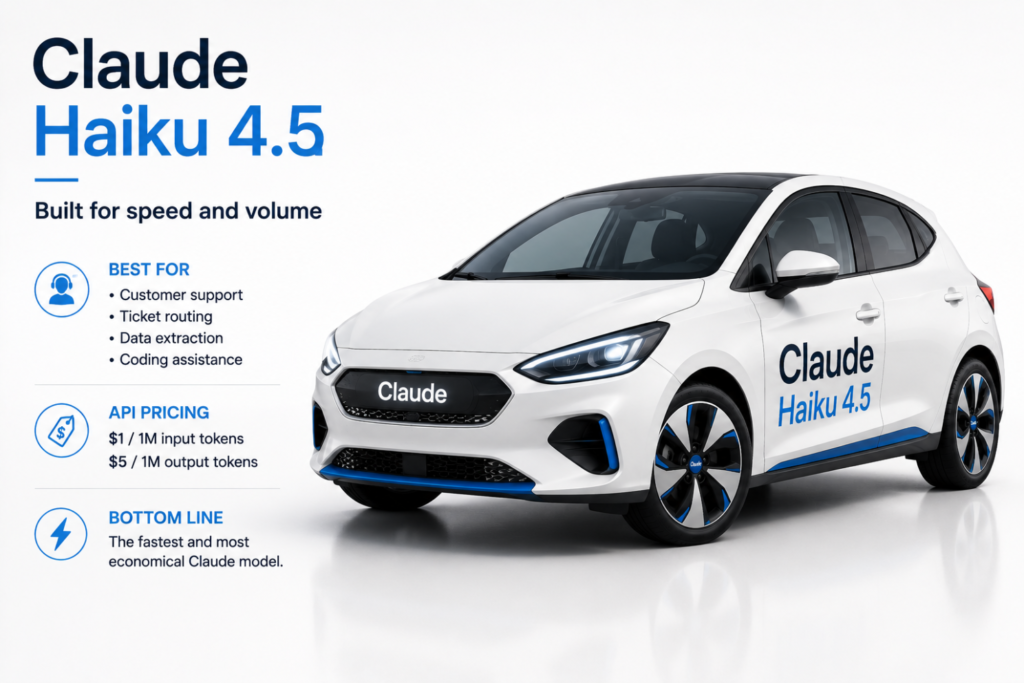
Haiku is Anthropic’s fastest and cheapest model, priced at $1 per million input tokens and $5 per million output tokens.
It suits tasks that happen often, need a fast reply and do not require deep reasoning: customer support chat, sorting incoming tickets, filtering content, pulling data out of documents and quick coding suggestions. Anthropic says Haiku 4.5 now codes about as well as Sonnet 4 did five months earlier, while costing roughly a third as much and running more than twice as fast.
Seen in practice: Warp, a coding tool built around an AI-powered terminal, switched to Haiku 4.5 for its agentic coding features. Its founder and chief executive, Zach Lloyd, said the change made a real difference to how the tool coordinates multiple AI sub-agents and handles computer-use tasks, to the point where AI-assisted coding in Warp now feels almost instant.
Gamma, a tool for building presentations, found something similar in a different setting: when generating slide text, Haiku 4.5 followed instructions correctly 65 per cent of the time, against 44 per cent for the more expensive model Gamma had been using before. Its co-founder, Jon Noronha, called this a genuine shift in what the tool costs to run.
Where it fits: anything high-volume, time-sensitive and not especially complex.
Sonnet 5: the everyday choice

Sonnet is the model Anthropic recommends starting with for most work. It strikes a balance between capability, speed and cost that suits writing, coding, research, business analysis, document review and agent-based workflows that need to run reliably at scale.
Sonnet 5 came out on 30 June 2026, and Anthropic describes it as a solid step up from Sonnet 4.6 in reasoning, tool use, coding and general knowledge work, closing some of the gap with Opus 4.8 on certain tasks. It launched at a discounted rate of $2 per million input tokens and $10 per million output tokens, a price that holds until 31 August 2026, after which it rises to $3 and $15. It is also the model set by default for anyone on a Claude Free or Pro plan, though Max, Team and Enterprise users can choose a different one if they prefer.
Seen in practice: ClickHouse, which builds analytics database software, uses Sonnet 5 to power agents that dig through live data and surface insights. Ryadh Dahimene, its director of product management for AI and machine learning, said the model reasons in smaller, tighter steps and gets users to a useful answer noticeably faster than before.
In insurance, the technology company Pace runs Sonnet 5 in agents that handle jobs like reading new submissions and processing claims. Its technical staff member Eric He said the model reliably picks the correct next action and does so at the pace real insurance teams actually need.
Where it fits: the sensible first choice for most day-to-day business tasks.
Opus 4.8: for harder problems that need real judgement
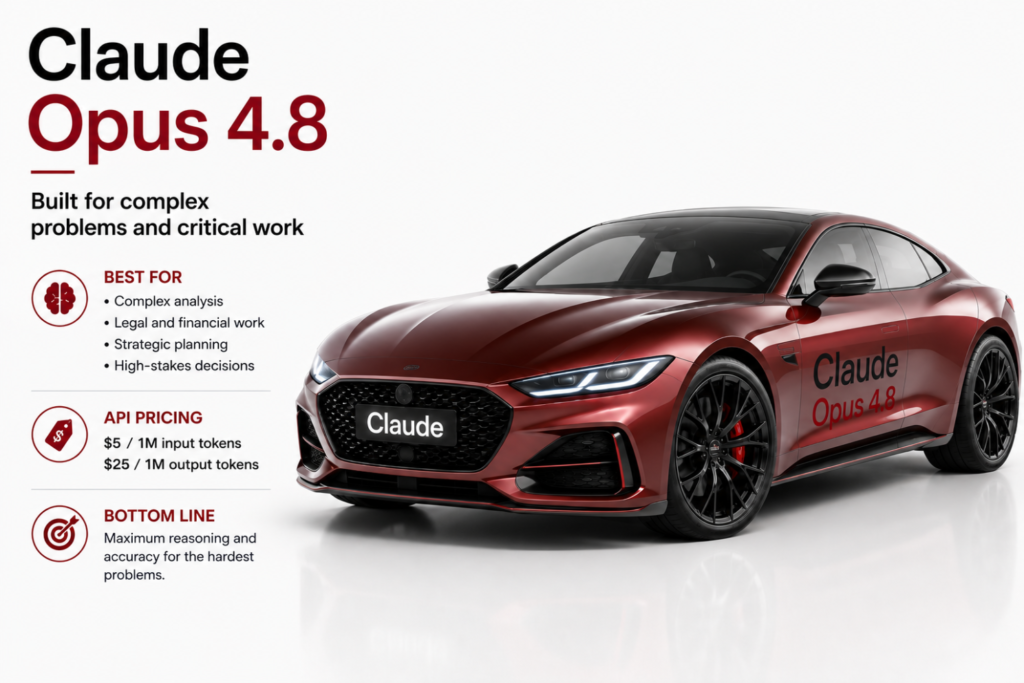
Opus is built for work that calls for more careful, sustained thinking than a general-purpose model can reliably offer: complex legal or financial analysis, difficult engineering decisions, reviewing dense or messy documents, and long agent tasks that need to keep track of a lot of moving parts.
Standard use costs $5 per million input tokens and $25 per million output tokens. Anthropic also offers a quicker version, called Fast Mode, at $10 and $50 per million tokens, for cases where speed matters as much as depth. Anthropic positions Opus as the model to bring in once Sonnet has been tried on a task and clearly needed more than it could give, rather than as an everyday default.
Seen in practice: Databricks built Opus 4.8 into Genie, its agent for data and knowledge work. According to Hanlin Tang, the company’s chief technology officer for neural networks, the new model handles deeper, multi-step questions faster than any earlier version of Opus, and its improved handling of images means Genie can now read PDFs and diagrams directly at 61 per cent lower token cost than it managed on Opus 4.7.
The financial technology firm Hebbia saw a related benefit in its own work with dense financial filings: chief technology officer Aabhas Sharma said Opus 4.8 matched the quality of its predecessor while noticeably improving citation accuracy and cutting the tokens needed for retrieval.
Where it fits: high-stakes work where getting the reasoning right matters more than saving money.
Fable 5: designed to work on its own for longer
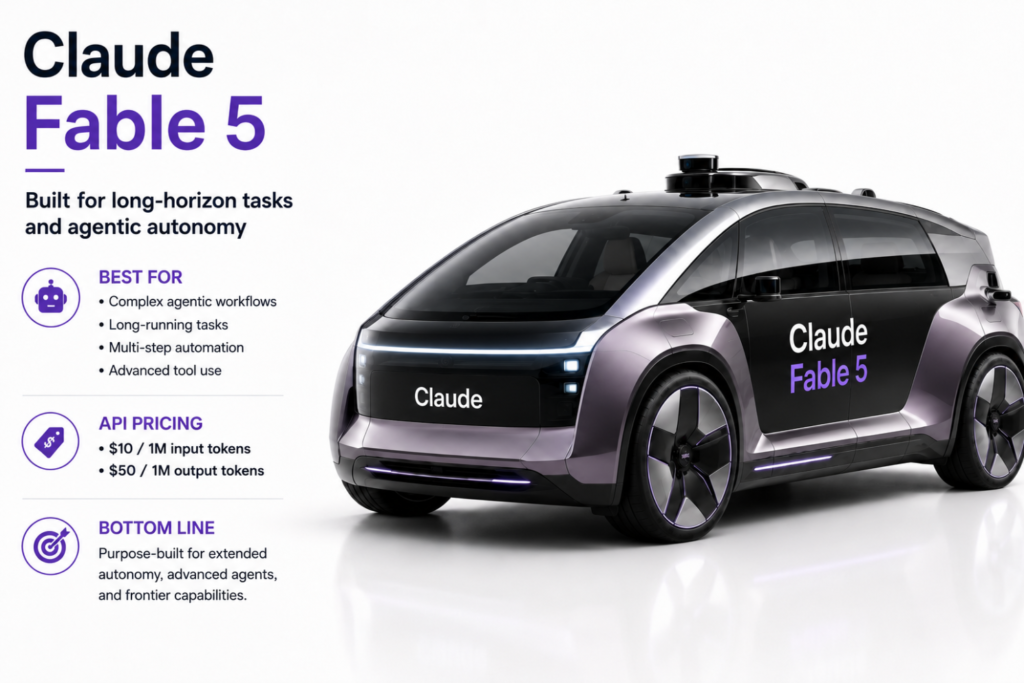
Fable is a step beyond the Haiku-Sonnet-Opus family. It belongs to a new class Anthropic calls Mythos-class, and when it launched on 9 June 2026 it became the first model at that level made available to the public.
Rather than simply reasoning more deeply in a single exchange, Fable is built to plan its own steps, use tools, notice and recover from its own mistakes, and keep working on a large task with far less need for a person to check in along the way.
At $10 per million input tokens and $50 per million output tokens, it costs more than any of the other tiers, so it makes little financial sense for routine writing or simple questions. Its value shows up on projects big and complex enough that letting the model work independently saves real time and coordination effort.
Fable 5’s launch was not entirely smooth, and it is worth knowing why. Shortly after Fable 5 and Mythos 5 launched, the US Department of Commerce placed export controls on both models on 12 June 2026, requiring Anthropic to restrict access to non-US nationals.
Because there was no reliable way to check every user’s nationality in real time, Anthropic suspended both models for all users, not only those affected by the restriction. The controls were lifted on 30 June, and Anthropic restored global access to Fable 5 on 1 July.
At the same time, it also rolled out an improved safety classifier addressing a jailbreak technique that had been reported to the company, though this was a separate, parallel change rather than the reason access was paused in the first place.
Fable 5 also includes stronger built-in safeguards than Opus: certain requests touching on cybersecurity or biological risk may be blocked outright or automatically handed off to Opus 4.8 instead.
Seen in practice: Stripe tested Fable 5 against a Ruby codebase of around 50 million lines and had it carry out a migration across the entire codebase in a single day, a job Stripe estimated would otherwise have taken a full engineering team more than two months.
Anthropic points to this as the clearest illustration of what Fable is for: the longer, messier and harder to supervise a task is, the bigger the advantage it offers over the other models.
Where it fits: large, long-running projects where independent execution is worth paying for.
Mythos 5
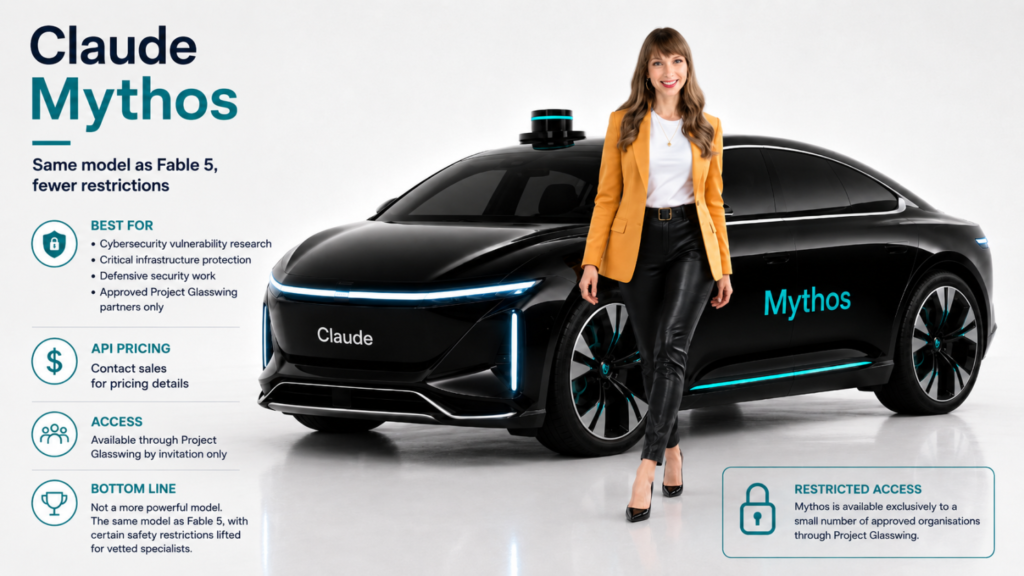
Mythos 5 runs on the same underlying model as Fable 5, but with some of its safety restrictions loosened for a small number of vetted organisations working in areas like cybersecurity and critical infrastructure protection. It is not something most businesses can sign up for. Access goes through Project Glasswing, Anthropic’s invitation-only programme, and there is no public sign-up route. For most readers, it is worth knowing this tier exists more than it is worth evaluating it directly.
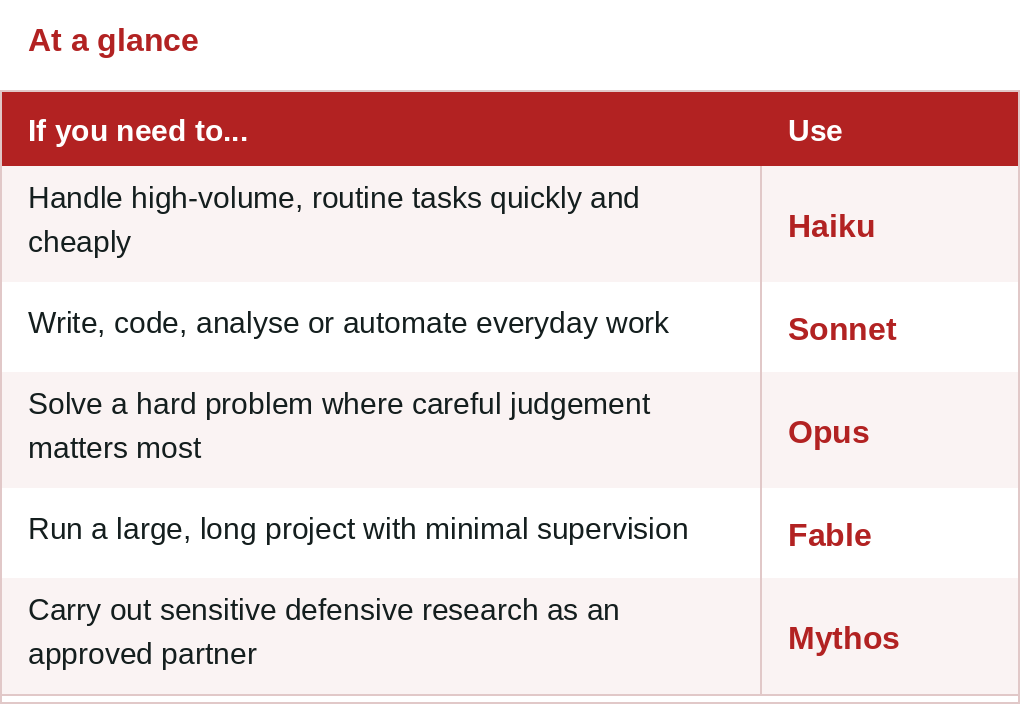
How to actually choose
It is easy to assume the Claude lineup is a straightforward hierarchy, with each model simply more capable than the last. That assumption overlooks the real design philosophy behind the range.
Start with Sonnet and only move up when there is a clear reason to.
Try Opus once you have tested a task on Sonnet and seen for yourself that it needs more depth or judgement than Sonnet is giving you.
Treat Fable as the exception rather than the default: reach for it only when a job is large and complicated enough that working with less supervision genuinely saves you time, given how much more it costs to run.
Guessing is not really necessary here.
Try the same task on a couple of models and compare how accurate and complete the results are, how long they take, how many tokens they use, how often you have to step in and correct the output, and how consistent the results are if you run it again. A model with a higher price tag can still work out cheaper overall if it gets the job done in fewer attempts and needs less checking. Equally, a smaller model can be the better economic choice for a narrow, well-defined task.
It is easy to picture these models as rungs on one ladder, with Haiku at the bottom and Fable at the top, but that undersells what is actually going on. Each one is built for a different job, not just more or less of the same job.
None of this is about reaching for the most powerful model available. It is about using the one that gets the job done properly, and knowing when a task has actually outgrown it.
Over to you
Before your next AI decision, it is worth asking a few plain questions. Which tasks in your business are running on a model doing far more than the job needs? Which ones are stuck on something that cannot keep up? And who is actually making that call?
If you would like a second opinion on any of this, get in touch with GenFutures Lab. We help businesses work out where AI genuinely belongs in how they operate, and where it does not.
If you found this edition useful, please consider forwarding it to a colleague.
Lorem ipsum dolor sit amet, consectetur adipiscing elit. Ut elit tellus, luctus nec ullamcorper mattis, pulvinar dapibus leo.